The guarantee of Full Refund
Our website ensures that DSA-C03 braindumps files can help you pass real exam at your first try. If you failed the exam with DSA-C03 valid vce, we will full refund the payment you make for our products. You only need to attach your score report to our support, then we will give you refund immediately after confirm your score.
After purchase, Instant Download: Upon successful payment, Our systems will automatically send the product you have purchased to your mailbox by email. (If not received within 12 hours, please contact us. Note: don't forget to check your spam.)
Pass DSA-C03 practice test at first try
DSA-C03 test answers and test questions are written and verified according to the latest knowledge points and current certification exam information. And we are equipped with a team of IT professionals who have rich experience in DSA-C03 practice test and they focus on the study of DSA-C03 test braindumps to accelerate the success of pass exam. Besides, our SnowPro Advanced: Data Scientist Certification Exam valid vce are updated regularly as well which give you 100% success in real exam.
Only with our latest Snowflake DSA-C03 braindumps files, you will be able to clear your real exam with top scores when you will have finished the updated exam preparation materials. Your success is 100% guaranteed by using our DSA-C03 test engine. It not only ensures you get exam with highest score but also save your money and time with DSA-C03 test braindumps. The key of our success is guaranteeing the interest of our customers with the most reliable Snowflake DSA-C03 test questions and the best quality service. Our dumps will bring you the new experience to prepare SnowPro Advanced valid vce in a smartest way. We are happy that our candidates are fully satisfied with our DSA-C03 practice test and study materials.

Our DSA-C03 braindumps files begin with the questions and answers that will accelerate your training and test your ability. We deliver the real information to you through DSA-C03 test dumps with a wide variety of settings and options. It will guarantee your success and save your money with our DSA-C03 practice test. With SnowPro Advanced: Data Scientist Certification Exam test answers download you receive our promise of passing test 100%. How can we do this? Every questions of our DSA-C03 test engine are written and technically tested by our IT professionals. The questions and answers from our DSA-C03 valid vce are the standard that more IT workers choose to pass their exams.
Our DSA-C03 test dumps contain everything you need to overcome the difficulty of real exam. It will be good helper if you prepare DSA-C03 test questions and review the pass guide skillfully. I believe you will pass exam with high marks.
The convenience of online test engine
Online test engine enjoy the great popularity among IT personnel because it is a way of exam simulation that make you feel the atmosphere of DSA-C03 practice test. You can test yourself and know well your weakness from DSA-C03 test engine materials. It has no limitation of the number of you installed and allows you practice your DSA-C03 test answers anytime.
Enjoy one-year free update
Customers who purchased our DSA-C03 test questions can enjoy free update in one year. We promise you will have enough time to prepare your DSA-C03 practice test. Once there are any updating of DSA-C03 test dumps, we will send it to your email immediately. You just need to check your mailbox.
Snowflake DSA-C03 Exam Syllabus Topics:
| Section | Weight | Objectives |
|---|---|---|
| Snowflake Data Science Best Practices | 15%–20% | - Performance Optimization
|
| Generative AI and LLM Capabilities | 10%–15% | - GenAI in Snowflake
|
| Data Science Concepts | 10%–15% | - Data Science Workflow
|
| Data Preparation and Feature Engineering | 25%–30% | - Feature Engineering
|
| Model Development and Machine Learning | 25%–30% | - Model Training
|
Snowflake SnowPro Advanced: Data Scientist Certification Sample Questions:
1. You are tasked with building a predictive model in Snowflake to identify high-value customers based on their transaction history. The 'CUSTOMER_TRANSACTIONS table contains a 'TRANSACTION_AMOUNT column. You need to binarize this column, categorizing transactions as 'High Value' if the amount is above a dynamically calculated threshold (the 90th percentile of transaction amounts) and 'Low Value' otherwise. Which of the following Snowflake SQL queries correctly achieves this binarization, leveraging window functions for threshold calculation and resulting in a 'CUSTOMER SEGMENT column?
A) Option A
B) Option C
C) Option B
D) Option D
E) Option E
2. You are developing a real-time fraud detection system using Snowflake and an external function. The system involves scoring incoming transactions against a pre-trained TensorFlow model hosted on Google Cloud A1 Platform Prediction. The transaction data resides in a Snowflake stream. The goal is to minimize latency and cost. Which of the following strategies are most effective to optimize the interaction between Snowflake and the Google Cloud A1 Platform Prediction service via an external function, considering both performance and cost?
A) Implement a caching mechanism within the external function (e.g., using Redis on Google Cloud) to store frequently accessed model predictions, thereby reducing the number of calls to the Google Cloud A1 Platform Prediction service. This requires managing cache invalidation.
B) Use a Snowflake pipe to automatically ingest the data from the stream, and then trigger a scheduled task that periodically invokes a stored procedure to train the model externally.
C) Implement asynchronous invocation of the external function from Snowflake using Snowflake's task functionality. This allows Snowflake to continue processing transactions without waiting for the response from the Google Cloud A1 Platform Prediction service, but requires careful monitoring and handling of asynchronous results.
D) Invoke the external function for each individual transaction in the Snowflake stream, sending the transaction data as a single request to the Google Cloud A1 Platform Prediction service.
E) Batch multiple transactions from the Snowflake stream into a single request to the external function. The external function then sends the batched transactions to the Google Cloud A1 Platform Prediction service in a single request. This increases throughput but might introduce latency.
3. You're working with a large dataset of user transactions in Snowflake. You need to identify potential outliers in transaction amounts C TRANSACTION AMOUNT) for each user CUSER ID'). Your goal is to flag transactions that are more than 3 standard deviations away from the mean transaction amount for that specific user. Which of the following approaches, utilizing Snowflake's statistical functions and window functions, would be MOST efficient and accurate for achieving this?
A) Calculating the overall mean and standard deviation for all transactions and filtering transactions based on those global statistics.
B) Creating a stored procedure that iterates through each user and calculates the mean and standard deviation individually.
C) Exporting the data to a Python environment, performing the calculations using Pandas, and then re-importing the results to Snowflake.
D) Using window functions to calculate the mean and standard deviation for each user within the same query, and then comparing each transaction amount to the calculated range.
E) Using a correlated subquery to calculate the mean and standard deviation for each user and then filtering the transactions.
4. You are using the NetworkX library in Snowpark Python to analyze social network data stored in a Snowflake table named 'USER CONNECTIONS', which has columns 'USER ID' and 'CONNECTED USER representing connections between users. You want to find the users with the highest 'betweenness centrality' to identify influential nodes in the network. Which Snowpark Python code snippet would correctly calculate and display the top 5 users with the highest betweenness centrality?
A) 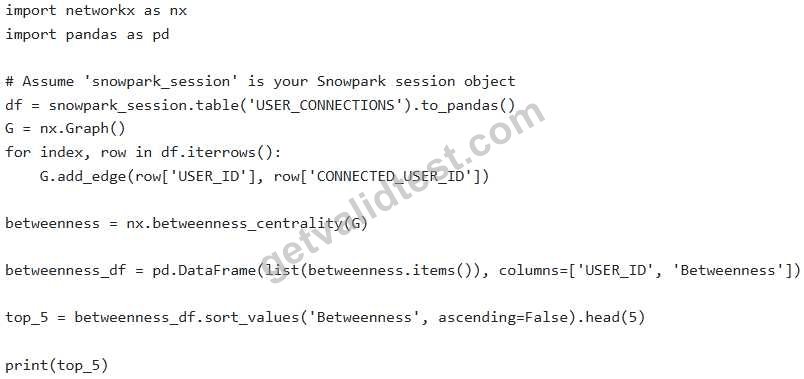
B) 
C) 
D) 
E) 
5. You are deploying a large language model (LLM) to Snowflake using a user-defined function (UDF). The LLM's model file, '11m model.pt', is quite large (5GB). You've staged the file to Which of the following strategies should you employ to ensure successful deployment and efficient inference within Snowflake? Select all that apply.
A) Use the 'IMPORTS' clause in the UDF definition to reference Ensure the UDF code loads the model lazily (i.e., only when it's first needed) to minimize startup time and memory usage.
B) Leverage Snowflake's Snowpark Container Services to deploy the LLM as a separate containerized application and expose it via a Snowpark API. Then call that endpoint from snowflake.
C) Split the large model file into smaller chunks and stage each chunk separately. Reassemble the model within the UDF code before inference.
D) Increase the warehouse size to XLARGE or larger to provide sufficient memory for loading the large model into the UDF environment.
E) Use the 'PUT' command with to compress the model file before staging it. Snowflake will automatically decompress it during UDF execution.
Solutions:
| Question # 1 Answer: A,B,C | Question # 2 Answer: A,C,E | Question # 3 Answer: D | Question # 4 Answer: C | Question # 5 Answer: A,B,D |