Only with our latest Microsoft 070-503 braindumps files, you will be able to clear your real exam with top scores when you will have finished the updated exam preparation materials. Your success is 100% guaranteed by using our 070-503 test engine. It not only ensures you get exam with highest score but also save your money and time with 070-503 test braindumps. The key of our success is guaranteeing the interest of our customers with the most reliable Microsoft 070-503 test questions and the best quality service. Our dumps will bring you the new experience to prepare MCTS valid vce in a smartest way. We are happy that our candidates are fully satisfied with our 070-503 practice test and study materials.

Our 070-503 braindumps files begin with the questions and answers that will accelerate your training and test your ability. We deliver the real information to you through 070-503 test dumps with a wide variety of settings and options. It will guarantee your success and save your money with our 070-503 practice test. With TS: Microsoft .NET Framework 3.5 C Windows Communication Foundation test answers download you receive our promise of passing test 100%. How can we do this? Every questions of our 070-503 test engine are written and technically tested by our IT professionals. The questions and answers from our 070-503 valid vce are the standard that more IT workers choose to pass their exams.
Our 070-503 test dumps contain everything you need to overcome the difficulty of real exam. It will be good helper if you prepare 070-503 test questions and review the pass guide skillfully. I believe you will pass exam with high marks.
The guarantee of Full Refund
Our website ensures that 070-503 braindumps files can help you pass real exam at your first try. If you failed the exam with 070-503 valid vce, we will full refund the payment you make for our products. You only need to attach your score report to our support, then we will give you refund immediately after confirm your score.
After purchase, Instant Download: Upon successful payment, Our systems will automatically send the product you have purchased to your mailbox by email. (If not received within 12 hours, please contact us. Note: don't forget to check your spam.)
The convenience of online test engine
Online test engine enjoy the great popularity among IT personnel because it is a way of exam simulation that make you feel the atmosphere of 070-503 practice test. You can test yourself and know well your weakness from 070-503 test engine materials. It has no limitation of the number of you installed and allows you practice your 070-503 test answers anytime.
Pass 070-503 practice test at first try
070-503 test answers and test questions are written and verified according to the latest knowledge points and current certification exam information. And we are equipped with a team of IT professionals who have rich experience in 070-503 practice test and they focus on the study of 070-503 test braindumps to accelerate the success of pass exam. Besides, our TS: Microsoft .NET Framework 3.5 C Windows Communication Foundation valid vce are updated regularly as well which give you 100% success in real exam.
Enjoy one-year free update
Customers who purchased our 070-503 test questions can enjoy free update in one year. We promise you will have enough time to prepare your 070-503 practice test. Once there are any updating of 070-503 test dumps, we will send it to your email immediately. You just need to check your mailbox.
Microsoft 070-503 Exam Syllabus Topics:
| Section | Objectives |
|---|---|
| Security, Transactions and Reliability | - Transactions, concurrency and instance management - Configuring security (transport and message level) - Reliable messaging and error handling |
| Windows Communication Foundation Fundamentals | - Service contracts, data contracts, and message contracts - Understanding WCF architecture and programming model - Bindings, endpoints, and host configuration |
| Service Implementation and Hosting | - Implementing service contracts in C# using .NET Framework 3.5 - Configuring service behavior and metadata exposure - Hosting WCF services in managed applications, IIS and WAS |
| Client Configuration and Communication | - Bindings and interoperability considerations - Channel factories and proxy generation - Creating and configuring WCF client applications |
Microsoft TS: Microsoft .NET Framework 3.5 C Windows Communication Foundation Sample Questions:
1. You create a Windows Communication Foundation service by using Microsoft .NET Framework 3.5.
The service receives automation commands for a factory robot.
You need to ensure that the robot receives the commands in the same order as they are transmitted.
Which binding element should you use?
A) <reliableSession/>
B) <compositeDuplex/>
C) <security/>
D) <transactionFlow/>
2. You are creating a Windows Communication Foundation (WCF) service by using Microsoft .NET Framework 3.5.
You create an instance of the ServerHost class. You plan to host the WCF service in a Windows service.
You need to link the lifetime of the WCF service to the lifetime of the Windows service.
Which three actions should you perform on the instance of the ServerHost class? (Each correct answer presents part of the solution. Choose three.)
A) Override the OnStart method.
B) Subscribe to the Faulted event.
C) Override the InitializeLifetimeService method.
D) Override the GetLifetimeService method.
E) Override the OnStop method.
F) Override the RequestAdditionalTime method.
3. You are creating a Windows Communication Foundation application by using Microsoft .NET Framework 3.5.
You create a service that provides access to the intranet file server of your company. Users must be able to update and delete files from the server by using the service.
You write the following code segment.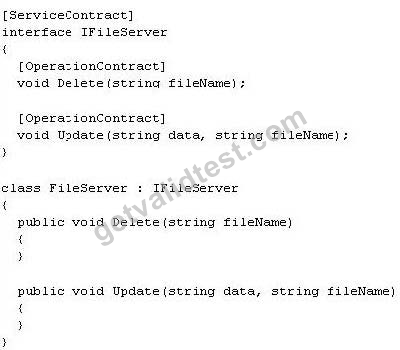
You need to ensure that files can be updated or deleted only by users with the required privileges defined in the server's file system ACLs. What should you do?
A) Define the service behavior in the following manner.
<serviceAuthorization impersonateCallerForAllOperations="true" />
Decorate the Delete and Update methods of the IFileServer interface by using the following
attribute.
[OperationBehavior(Impersonation=ImpersonationOption.Alloraed)]
B) Define the service behavior in the following manner.
<serviceAuthorization impersonateCallerForAllOperations="false" />
Decorate the Delete and Update methods of the FileServer class by using the following
attribute.
[OperationBehavior(Impersonation=ImpersonationOption.Required )]
C) Define the service behavior in the following manner.
<serviceAuthorization impersonateCallerForAllOperations="true" />
D) Define the service behavior in the following manner.
<serviceAuthorization impersonateCallerForAllOperations="false" />
Decorate the Delete and Update methods of the IFileServer interface by using the following
attribute.
[OperationBehavior(Impersonation=ImpersonationOption.Required)]
4. You are creating a Windows Communication Foundation service by using Microsoft .NET Framework 3.5. You create the following service contract. (Line numbers are included for reference only.)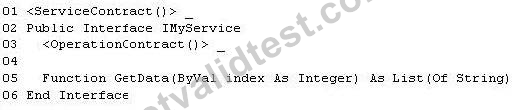
You need to ensure that the GetData operation can be accessed by using the URI in the following manner:
Which code segment should you insert at line 04?
A) Option A
B) Option C
C) Option B
D) Option D
5. You are creating a distributed application by using Microsoft .NET Framework 3.5.
The application uses the Windows Communication Foundation model.
You need to ensure that the following requirements are met:
What are two possible ways to achieve this goal? (Each correct answer presents a complete solution. Choose two.)
A) <bindings> <wsHttpBinding> <binding name="main"> <security
mode="TransportWithMessageCredential bindings>
B) <bindings>
<netTcpBinding>
<binding name="main">
<security mode="TransportWithMessageCredential
<message clientCredentialType="Certificate7>
</security> </binding> </netTcpBinding></bindings>
> </security> </binding> </wsHttpBinding></
> transport clientCredentialType="Certificate" />
> transport clientCredentialType="Windows" />
> transport clientCredentialType="Certificate" />
C) <bindings> <wsHttpBinding> <binding name="main"> <security
mode="TransportWithMessageCredential <message clientCredentialType="None7>
</security> </binding> </wsHttpBindingx/bindings>
D) <bindings> <wsHttpBinding> <binding name="main"> <security
mode="TransportWithMessageCredential <message clientCredentialType="None"/>
</security> </binding> </wsHttpBindingx/bindings>
Solutions:
| Question # 1 Answer: C | Question # 2 Answer: A,D,E | Question # 3 Answer: B | Question # 4 Answer: A | Question # 5 Answer: A,B |