If you think that you have enough time to prepare your MEDICAL LABORATORY TECHNICIAN - MLT(ASCP) actual test, we will provide you with the latest study materials so that you can clear MEDICAL LABORATORY TECHNICIAN - MLT(ASCP) valid test with full confidence. Our website has focused on providing our candidates with the most reliable ASCP braindumps torrent with the best quality service. We are here to offer you instant help so that you can get high scores in the ASCP-MLT valid test. Our latest training materials and test questions will surely give you all want for MEDICAL LABORATORY TECHNICIAN - MLT(ASCP) pass test guaranteed. Many candidates realized that it is exhausted thing to join the classes and prefer to choose our MEDICAL LABORATORY TECHNICIAN - MLT(ASCP) exam braindumps as their prior pass guide. Our MLT(ASCP) test questions and answers are the best learning materials for preparing their certification.

You must be heard that our latest ASCP-MLT test answers can ensure candidates clear exam with 100% and covers everything you want to solve the difficulties of MEDICAL LABORATORY TECHNICIAN - MLT(ASCP) test questions. All study materials are concluded and tested by our team of IT experts who are specialized in MEDICAL LABORATORY TECHNICIAN - MLT(ASCP) valid dumps. We always keep the updating of our study materials so that our candidates get high marks in the ASCP actual test with great confidence. Besides, there are free demo you can download to check the accuracy of MEDICAL LABORATORY TECHNICIAN - MLT(ASCP) test answers.
There are three versions for the preparation of your MEDICAL LABORATORY TECHNICIAN - MLT(ASCP) braindumps torrent. One is Pdf version that can be printable and shared your MEDICAL LABORATORY TECHNICIAN - MLT(ASCP) test questions with your friends. The test engine and online test engine is exam simulation that bring you feel the atmosphere of ASCP-MLT valid test. Online version allows you practice your questions in any electronic equipment without limitation. You can check the test result of MEDICAL LABORATORY TECHNICIAN - MLT(ASCP) exam braindumps after test.
Our aim is offering our customer the most accurate MEDICAL LABORATORY TECHNICIAN - MLT(ASCP) exam braindumps and the most comprehensive service, that's our key of success. You will enjoy one-year free update once you purchased our MEDICAL LABORATORY TECHNICIAN - MLT(ASCP) valid dumps. And once we have any updating about ASCP-MLT test answers, we will send it to your email immediately. Besides, we promise you full refund if you failed exam with our MEDICAL LABORATORY TECHNICIAN - MLT(ASCP) pass test guaranteed materials. Please feel free to contact us if you have any questions.
After purchase, Instant Download: Upon successful payment, Our systems will automatically send the product you have purchased to your mailbox by email. (If not received within 12 hours, please contact us. Note: don't forget to check your spam.)
ASCP ASCP-MLT Exam Syllabus Topics:
| Section | Weight | Objectives |
|---|---|---|
| Microbiology | 15–20% | - Bacteriology and mycology procedures - Virology and parasitology testing |
| Urinalysis and Other Body Fluids | 5–10% | - Microscopic analysis and disease correlation - Physical and chemical testing |
| Immunology | 5–10% | - Serologic procedures and immune diseases - Principles of immunology |
| Laboratory Operations | 5–10% | - Quality assessment and safety - Instrumentation and laboratory mathematics |
| Hematology | 20–25% | - Laboratory testing and hemostasis - Physiology and disease states |
| Blood Banking | 15–20% | - Blood products and components - Blood group systems and immunology - Transfusion practice and testing |
| Chemistry | 20–25% | - Carbohydrates, lipids, and enzymes - Electrolytes, acid-base, and toxicology |
ASCP MEDICAL LABORATORY TECHNICIAN - MLT(ASCP) Sample Questions:
1. No HLA matching is performed for corneal tissue transplants as the cornea occupies a privileged site not usually seen by the immune system. This term has been coined "immune privileged".
Corneal tissue may be transplanted successfully from one patient to another because:
A) Corneal antigens do not activate T cells
B) The cornea has the same DNA in everyone.
C) The cornea is non-antigenic
D) Anti-corneal antibodies are easily suppressed
E) The cornea occupies a privileged site not usually seen by the immune system
2. An ultrarapid metabolizer (UM) would require a higher dose of a drug than an EM (a person with normal enzyme activity) since the UM eliminates the drug more quickly.
A CYP2D6 ultrarapid metabolizer (UM) would require ___________ dose of an active drug (non-prodrug) that is metabolized by CYP2D6 than a CYP2D6 extensive metabolizer (EM).
A) the same
B) a higher
C) a lower
3. Thyroid-stimulating immunoglobulins, or TSI's, are IgG antibodies that can bind to thyrotropin (TSH) receptors on the thyroid gland. TSIs mimic the action of TSH, causing excess secretion of thyroxine and triiodothyronine. The TSI level is abnormally high in persons with hyperthyroidism due to Graves' disease.
Which of the following is an autoantibody that binds to TSH receptor sites on thyroid cell membranes preventing thyroid-stimulating hormone binding?
A) Antimicrosomal antibodies
B) Antithyroglobulin
C) Thyroid-stimulating immunoglobulins
D) Lupus erythematosus
E) Thyroxin-binding globulins
4. The ratio of blood to anticoagulant in a light blue stopper tube is:
A) 10:1
B) 9:1
C) 2:1
D) 5:1
5. The correct answer is Trichophyton rubrum. The tiny microconidia are lined up in a "birds on the fence" arrangement along the hyphal strand transversing the field of view (yellow arrows). Two pencil-shaped, smooth walled macroconidia are also seen in the lower left field of view (red arrows).
Trichophyton verrucosum may produce microconidia in small quantities. However, they are irregularly arranged with little tendency to line up along the hyphae. Antler hyphae and string bean macroconidia are characteristic of this species.
One of the key characteristics in the identification of Epidermophyton floccosum is the inability of this dermatophyte to produce microconidia. Two to four-celled, club-shaped macroconidia are produced, usually in clusters of two or three.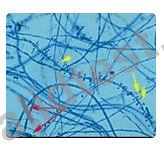
The profusion of tiny microconidia lining up along the hyphae in this photomicrograph is characteristic of which of the following organisms?
A) Epidermophyton floccosum
B) Trichophyton rubrum
C) Trichophyton verrucosum
Solutions:
| Question # 1 Answer: E | Question # 2 Answer: B | Question # 3 Answer: C | Question # 4 Answer: B | Question # 5 Answer: B |