Each set of exercises can be regarded as a real exam — the Salesforce Certified MuleSoft Platform Architect I SOFT version simulates the formal test model on unlimited Windows PCs: 154 practice questions for the MuleSoft-Platform-Architect-I exam at GetValidTest.
Salesforce MuleSoft-Platform-Architect-I Exam Syllabus Topics:
| Section | Weight | Objectives |
|---|---|---|
| Monitoring and Analyzing Application Networks | 8% | - Use Anypoint Platform monitoring tools - Analyze usage patterns and performance - Optimize based on operational data - Define metrics, logs, and alerts |
| Explaining Application Network Basics | 11% | - Understand Anypoint Platform components and their roles - Assign APIs to appropriate tiers - Describe role and characteristics of web APIs - Identify and differentiate technologies for API-led connectivity |
| Designing and Sharing APIs | 11% | - Design APIs using system, process, experience layers - Identify dependencies between API components - Map data models between bounded contexts - Create and publish reusable API assets |
| Architecting and Deploying API Implementations | 11% | - Compare deployment options: CloudHub, customer-hosted, hybrid - Identify VPC and network requirements - Use auto-discovery and service registration - Design for CI/CD and automated testing |
| Deploying API Implementations to CloudHub | 11% | - Configure CloudHub deployment settings - Size and optimize worker resources - Monitor and troubleshoot CloudHub applications - Manage scaling and high availability |
| Managing APIs | 12% | - Select and enforce API policies - Secure APIs using authentication and authorization - Understand OAuth 2.0 and OpenID Connect flows - Manage API instances and environments |
| Meeting API Quality Goals | 8% | - Apply caching and performance optimization - Design for horizontal and vertical scaling - Design resilience and fault tolerance strategies - Ensure API maintainability and reusability |
| Establishing Organizational and Platform Foundations | 17% | - Describe MuleSoft Catalyst framework - Advise on Center for Enablement (C4E) structure and KPIs - Compare identity and client management options - Identify data residency and compliance requirements |
| Applying Integration Patterns | 11% | - Apply patterns for message routing, transformation, and orchestration - Design for error handling and idempotency - Select appropriate integration patterns |
MuleSoft-Platform-Architect-I Exam FAQ — Your Strong Partner
120 minutes for 60-65 questions. The GetValidTest SOFT engine simulates the formal test model, so each exercise set trains the pacing you'll need.
Yes — try and download the free demos of the Salesforce Certified MuleSoft Platform Architect I PDF version before you buy; they show the model and style of the full torrent. Purchases include 365 days of free updates by email; renew afterward at 50% off.
No mandatory prerequisites; recommended experience with Anypoint Platform and enterprise integration Eligibility rules change over time, so verify the current requirements on the official page (official MuleSoft-Platform-Architect-I exam page) before registering.
Upon successful payment, our system emails the Salesforce Certified MuleSoft Platform Architect I material automatically within about a minute — in a safer environment with your personal information sealed tightly, and 24/7 help if nothing arrives within 2 hours. If you fail the corresponding MuleSoft-Platform-Architect-I exam within 60 days of purchase, we refund the full amount: send a scanned enrollment slip plus the official Score Report PDF within 2 days of the exam, processed within 7 days. Excluded: exams within 3 days of purchase, candidate names that don't match the payer, and free or expired products. Or exchange for two equal-value products free.
Through the vendor's official registration channels:
The Salesforce Certified MuleSoft Platform Architect I is delivered Online proctored or onsite at authorized testing centers — pick the arrangement that suits you when booking.
USD 400 per attempt, 70% to pass. Retakes cost the full fee — use your leisure time with the 154 practice questions for the MuleSoft-Platform-Architect-I exam at GetValidTest before booking.
The Salesforce Certified MuleSoft Platform Architect I blueprint spans 9 domains — including Meeting API Quality Goals (8%), Deploying API Implementations to CloudHub (11%), Managing APIs (12%). All three versions of our material cover the same content, with no discrepancy; the complete outline above lists every subtopic.
The Salesforce Certified MuleSoft Platform Architect I is Salesforce's certification exam for Salesforce Certified MuleSoft Platform Architect I, at the Architect level. It's a fundamental element for a higher position and a more promising future. Related credentials include Salesforce Certified MuleSoft Developer, Salesforce Certified MuleSoft Platform Integration Architect.
Yes:
After any course, keep practicing with the 154 practice questions for the Salesforce Certified MuleSoft Platform Architect I — every answer expert-verified.
Salesforce Certified MuleSoft Platform Architect I Sample Questions:
An Order API must be designed that contains significant amounts of integration logic and involves the invocation of the Product API.
The power relationship between Order API and Product API is one of "Customer/Supplier", because the Product API is used heavily throughout the organization and is developed by a dedicated development team located in the office of the CTO.
What strategy should be used to deal with the API data model of the Product API within the Order API?
- A. Start an organization-wide data modeling initiative that will result in an Enterprise Data Model that will then be used in both the Product API and the Order API
- B. Work with the API data types of the Product API directly when implementing the integration logic of the Order API such that the Order API uses the same (unchanged) data types as the Product API
- C. Convince the development team of the Product API to adopt the API data model of the Order API such that the integration logic of the Order API can work with one consistent internal data model
- D. Implement an anti-corruption layer in the Order API that transforms the Product API data model into internal data types of the Order API
Correct Answer: D 🗳️
Explanation: Only visible for GetValidTest members. You can sign-up / login (it's free).
A code-centric API documentation environment should allow API consumers to investigate and execute API client source code that demonstrates invoking one or more APIs as part of representative scenarios.
What is the most effective way to provide this type of code-centric API documentation environment using Anypoint Platform?
- A. Ensure the APIs are well documented through their Anypoint Exchange entries and API Consoles and share these pages with all API consumers
- B. Make relevant APIs discoverable via an Anypoint Exchange entry
- C. Create API Notebooks and include them in the relevant Anypoint Exchange entries
- D. Enable mocking services for each of the relevant APIs and expose them via their Anypoint Exchange entry
Correct Answer: C 🗳️
Explanation: Only visible for GetValidTest members. You can sign-up / login (it's free).
A company stores financial transaction data in two legacy systems. For each legacy system, a separate, dedicated System API (SAPI) exposes data for that legacy system. A Process API (PAPI) merges the data retrieved from ail of the System APIs into a common format. Several API clients call the PAPI through its public domain name.
The company now wants to expose a subset of financial data to a newly developed mobile application that uses a different Bounded Context Data Model. The company wants to follow MuleSoft's best practices for building out an effective application network.
Following MuleSoft's best practices, how can the company expose financial data needed by the mobile application in a way that minimizes the impact on the currently running API clients, API implementations, and support asset reuse?
- A. Develop and deploy is new PAPI implementation with data transformation and ... login to support this required endpoints of both mobile and web clients.
Deploy an API Proxy with an endpoint from API Manager that redirect the existing PAPI endpoints to the new PAPI. - B. Add two new Experience APIs (EAPI-i and EAPI-2}.
Add Mobile PAPI-2 to expose the Intended subset of financial data as requested.
Both PAPIs access the Legacy Systems via SAPI-1 and SAP]-2. - C. Add two new Experience APIs (EAPI-i and EAPI-2}.
Add Mobile PAPI-2 to expose the Intended subset of financial data as requested.
Both PAPIs access the Legacy Systems via SAPI-1 and SAP]-2. - D. Create a new mobile Experince API (EAPI) chat exposes that subset of PAPI endpoints.
Add transformtion login to the mobile Experince API implementation to make mobile data compatible with the required PAPIs.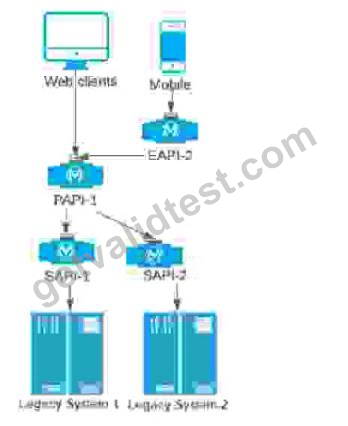
Correct Answer: B 🗳️
Explanation: Only visible for GetValidTest members. You can sign-up / login (it's free).
A business process is being implemented within an organization's application network. The architecture group proposes using a more coarse-grained application network design with relatively fewer APIs deployed to the application network compared to a more fine-grained design.
Overall, which factor typically increases with a more coarse-grained design for this business process implementation and deployment compared with using a more fine-grained design?
- A. The number of discoverable assets related to APIs deployed in the application network
- B. The usage of network infrastructure resources by the application network
- C. The number of possible connections between API implementations in the application network
- D. The complexity of each API implementation
Correct Answer: D 🗳️
Explanation: Only visible for GetValidTest members. You can sign-up / login (it's free).
A system API is deployed to a primary environment as well as to a disaster recovery (DR) environment, with different DNS names in each environment. A process API is a client to the system API and is being rate limited by the system API, with different limits in each of the environments. The system API's DR environment provides only 20% of the rate limiting offered by the primary environment. What is the best API fault-tolerant invocation strategy to reduce overall errors in the process API, given these conditions and constraints?
- A. Invoke the system API deployed to the primary environment; add timeout and retry logic to the process API to avoid intermittent failures; if it still fails, invoke a copy of the process API deployed to the DR environment
- B. Invoke the system API deployed to the primary environment; add timeout and retry logic to the process API to avoid intermittent failures; if it still fails, invoke the system API deployed to the DR environment
- C. Invoke the system API deployed to the primary environment; add retry logic to the process API to handle intermittent failures by invoking the system API deployed to the DR environment
- D. In parallel, invoke the system API deployed to the primary environment and the system API deployed to the DR environment; add timeout and retry logic to the process API to avoid intermittent failures; add logic to the process API to combine the results
Correct Answer: B 🗳️
Explanation: Only visible for GetValidTest members. You can sign-up / login (it's free).
Viewing page 1 out of 31 pages.
Viewing questions 1-5 out of 154 questions.