


Nov-2024 Qlik QSDA2024 Certification Real 2024 Mock Exam
QSDA2024 Exam Questions and Valid PMP Dumps PDF
Qlik QSDA2024 Exam Syllabus Topics:
| Topic | Details |
|---|---|
| Topic 1 |
|
| Topic 2 |
|
| Topic 3 |
|
| Topic 4 |
|
| Topic 5 |
|
NEW QUESTION # 11
A data architect needs to upload data from ten different sources, but only if there are any changes after the last reload. When data is updated, a new file is placed into a folder mapped to E:\486396169. The data connection points to this folder.
The data architect plans a script which will:
1. Verify that the file exists
2. If the file exists, upload it Otherwise, skip to the next piece of code.
The script will repeat this subroutine for each source. When the script ends, all uploaded files will be removed with a batch procedure. Which option should the data architect use to meet these requirements?
- A. FileSize, IF, THEN, END IF
- B. FileExists, FOR EACH, IF
- C. FilePath, FOR EACH, Peek, Drop
- D. FilePath, IF, THEN, Drop
Answer: B
NEW QUESTION # 12
A data architect receives an error while running script.
What will happen to the existing data model?
- A. The latest error-free data model will be maintained.
- B. The data model will be replaced with the tables that were successfully loaded before the error.
- C. Newly loaded tables will be merged with the existing data model until the error is resolved.
- D. The data model will be removed from the application.
Answer: A
Explanation:
In Qlik Sense, when a data load script is executed and an error occurs, the script execution is halted immediately, and any tables that were being loaded at the time of the error are discarded. However, the existing data model-i.e., the last successfully loaded data model-remains intact and is not affected by the failed script. This ensures that the application retains the last known good state of the data, avoiding any partial or inconsistent data loads that could occur due to an error.
When the script encounters an error:
* The tables that were successfully loaded prior to the error are retained in the session, but these tables are not merged with the existing data model.
* The existing data model before the script was executed remains unchanged and is maintained.
* No partial or incomplete data is loaded into the application; hence, the data model remains consistent and reliable.
Qlik Sense Data Architect ReferencesThis behavior is designed to protect the integrity of the data model. In scenarios where script execution fails, the user can debug and fix the script without risking the data integrity of the existing application. The key references include:
* Qlik Help Documentation: Provides detailed information on how Qlik Sense handles script errors, highlighting that the existing data model remains unchanged after an error.
* Data Load Editor Practices: Best practices dictate ensuring that the script is fully functional before executing it to avoid data inconsistency. In cases where an error occurs, understanding that the current data model is maintained helps in strategic debugging and script correction.
NEW QUESTION # 13
A data architect needs to acquire social media data for the past 10 years. The data architect needs to track all changes made to the source data, include all relevant fields, and reload the application four times a day.
What information does the data architect need?
- A. A field with social media source, a set of key fields to sort out updated records, configure reload task to load four times a day
- B. A field with ModificationTime, a primary key field to sort out updated records, insert and update records, remove records
- C. A field with ModificationTime, a primary key field to sort out updated records, insert and append records, update records
- D. A field with record creation time, a secondary key field to remove deleted records, configure reload task to load four times a day
Answer: B
Explanation:
The scenario describes a need to track social media data over the past 10 years, capturing all changes (inserts, updates, deletes) while reloading the data four times a day.
To manage this:
* ModificationTime: This field is essential for tracking changes over time. It indicates when a record was last modified, allowing the script to determine whether it needs to insert, update, or delete records.
* Primary Key Field: A primary key is crucial for uniquely identifying records. It enables the script to match records in the source with those already loaded, facilitating updates and deletions.
* Insert and Update Records: The script should handle both inserting new records and updating existing ones based on the ModificationTime.
* Remove Records: If records are deleted in the source, they should also be removed in the Qlik Sense data model to maintain consistency.
This approach ensures that all changes in the social media data are accurately captured and reflected in the Qlik Sense application.
NEW QUESTION # 14
Exhibit.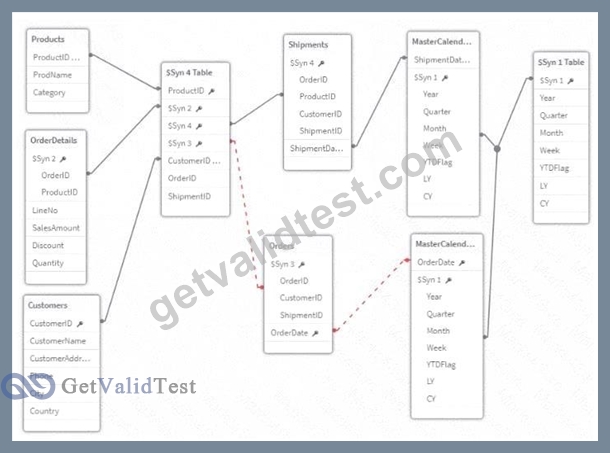
Refer to the exhibit.
A data architect is working on a Qlik Sense app the business has created to analyze the company orders and shipments.
To understand the table structure, the business has given the following summary:
* Every order creates a unique orderlD and an order date in the Orders table
* An order can contain one or more order lines one for each product ID in the order details table
* Products In the order are shipped (shipment date) as soon as they are ready and can be shipped separately
* The dates need to be analyzed separately by Year, Month, and Quarter
The data architect realizes the data model has issues that must be fixed. Which steps should the data architect perform?
- A. 1. Create a key with OrderlD and ProductID In the OrderDetails table and in the Orders table
2. Delete the ShipmentID in the Shipments table
3. Delete the ProductID and OrderlD in the OrderDetails table
4. Concatenate Orders and OrderDetails
5. Create a link table using the MasterCalendar table and create a concatenated field between OrderDate and ShipmentDate - B. 1. Create a key with OrderlD and ProductID in the OrderDetails table and in the Shipments table
2. Delete the ShipmentID in the Orders table
3. Delete the ProductID and OrderlD in the Shipments table
4. Left join Orders and OrderDetails
5. Use Derive statement with the MasterCalendar table and apply the derive fields to OrderDate and ShipmentDate - C. 1. Create a key with OrderlD and ProductID in the OrderDetails table and in the Shipments table
2. Delete the ShipmentID in the Orders table
3. Delete the ProductID and OrderlD In the Shipments table
4. Concatenate Orders and OrderDetails
5. Create a link table using the MasterCalendar table and create a concatenated field between OrderDate and ShipmentDate - D. 1. Create a key with OrderlD and ProductID in the OrderDetails table and in the Orders table
2. Delete the ShipmentID in the Shipments table
3. Delete the ProductID and OrderlD in the OrderDetails table
4. Left join Orders and OrderDetails
5. Use Derive statement with the MasterCalendar table and apply the derive fields to OrderDate and ShipmentDate
Answer: C
Explanation:
In the given data model, there are several issues related to table relationships and key fields that need to be addressed to create a functional and optimized data model. Here's how each step in the chosen solution (Option C) resolves these issues:
* Create a key with OrderID and ProductID in the OrderDetails table and in the Shipments table:
* By creating a composite key with OrderID and ProductID, you uniquely identify each line item in both the OrderDetails and Shipments tables. This step is crucial for ensuring that each product within an order is correctly associated with its respective shipment.
* Delete the ShipmentID in the Orders table:
* The ShipmentID in the Orders table is redundant because the Shipments table already captures this information at a more granular level (i.e., at the product level). Removing ShipmentID avoids potential circular references or synthetic keys.
* Delete the ProductID and OrderID in the Shipments table:
* After creating the composite key in step 1, the individual ProductID and OrderID fields in the Shipments table are no longer necessary for joins. Removing them reduces redundancy and simplifies the table structure.
* Concatenate Orders and OrderDetails:
* Concatenating Orders and OrderDetails into a single table creates a unified table that contains all necessary order-related information. This helps in simplifying the model and avoiding issues related to managing separate but related tables.
* Create a link table using the MasterCalendar table and create a concatenated field between OrderDate and ShipmentDate:
* A link table is created to associate the combined table with the MasterCalendar. By creating a concatenated field that combines OrderDate and ShipmentDate, you ensure that both dates are properly linked to the calendar, allowing for accurate time-based analysis.
NEW QUESTION # 15
Exhibit.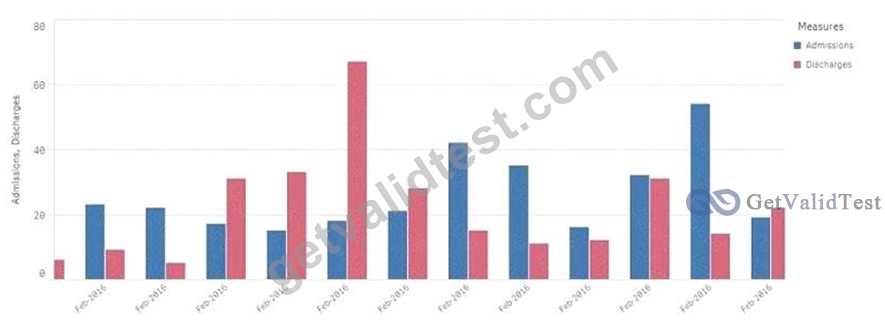
A chart for monthly hospital admissions and discharges incorrectly displays the month and year values on the x-axis.
The date format for the source data field "Common Date" is M/D/YYYY. This format was used in a calculated field named "Month-Year" in the data manager when the data model was first built.
Which expression should the data architect use to fix this issue?
- A. Date(MonthStart([Common Date]),'MMM-YYYY')
- B. Date(InMontht[Common Date]),'MMM-YYYY')
- C. Date(MonthsStart([Common Date]),'VMM-YYYY')
- D. Date([Comraon Date],'MMM-YYYY')
Answer: A
Explanation:
The issue described relates to the incorrect display of month and year values on the x-axis of a chart. The source data has dates in the M/D/YYYY format, and a calculated field named Month-Year was created using this date format.
To correct the issue:
* The correct approach is to use the MonthStart() function, which returns the first date of the month for the provided date. This ensures consistency in month-year representation.
* The Date() function is then used to format the result of MonthStart() to the desired format of MMM- YYYY (e.g., Feb-2018).
Explanation of the Correct Expression:
* MonthStart([Common Date]): This ensures that all dates within a month are treated as the first day of that month, which is critical for accurate monthly aggregation.
* Date(..., 'MMM-YYYY'): This formats the result to show just the month and year in the correct format.
Using this expression ensures that the x-axis correctly displays the month-year values.
NEW QUESTION # 16
A data architect implements Section Access on an app to reduce the data for each user when the user logs in.
Each user is allowed to see their specific territory only.
The app is set for a scheduled reload every three hours. Without Section Access added, the app loads successfully. When Section Access is added and the script runs, the app fails to load.
What is causing this issue?
- A. The ACCESS Column in the Section Access table has been added in lowercase.
- B. The data architect does not have rights to reload the app.
- C. The service account running the task is not included in the Section Access table.
- D. A user name listed in the Section Access table is spelled incorrectly.
Answer: C
Explanation:
When implementing Section Access in Qlik Sense, it is crucial that all accounts that need to access the data- including the service account that performs the scheduled reload-are included in the Section Access table. If the service account is not included, Qlik Sense will not be able to access any data, leading to a failure in the reload process.
Here's a breakdown of why the other options are less likely:
* A. The ACCESS column in the Section Access table has been added in lowercase:This would generally result in a syntax error, but it would not allow the script to execute successfully without causing an immediate failure, unrelated to Section Access.
* C. A user name listed in the Section Access table is spelled incorrectly:While this could lead to some users not having the correct access, it would not cause the entire reload to fail. The issue here is broader, affecting the entire application load process.
* D. The data architect does not have rights to reload the app:If the architect did not have rights, the script would not run successfully even without Section Access.
The correct issue in this scenario is thatthe service account running the task is not included in the Section Access table. This is a common cause of load failures after adding Section Access. To resolve this, ensure that the service account is added with sufficient privileges in the Section Access table
NEW QUESTION # 17
A data architect needs to retrieve data from a REST API. The data architect needs to loop over a series of items that are being read using the REST connection.
What should the data architect do?
- A. Recreate the SQL Statement with the correct parameters
- B. Use pagination of the REST Connector to create a template of the desired data
- C. Use the REST Connector with pagination mechanism
- D. Use With Connection to pass a parameter to the REST URL
Answer: C
Explanation:
When retrieving data from a REST API, particularly when the dataset is large or the data is segmented across multiple pages (which is common in REST APIs), the REST Connector in Qlik Sense needs to be configured to handle pagination.
Pagination is the process of dividing the data retrieved from the API into pages that can be loaded sequentially or as required. Qlik Sense's REST Connector supports pagination by allowing the dataarchitect to set parameters that will sequentially retrieve each page of data, ensuring that the complete dataset is retrieved.
Key Steps:
* REST Connector Setup: Configure the REST connector in Qlik Sense and specify the necessary API endpoint.
* Pagination Mechanism: Use the built-in pagination mechanism to define how the connector should retrieve the subsequent pages (e.g., by using query parameters like page or offset).
NEW QUESTION # 18
A data architect executes the following script:
What will be the result of Table.A?
- A.

- B.

- C.

- D.

Answer: C
Explanation:
In the script provided, there are two tables being loaded inline: Table_A and Table_B. The script uses the Join function to combine Table_B with Table_A based on the common field Field_1. Here's how the join operation works:
* Table_Ainitially contains three records with Field_1 values of 01, 01, and 02.
* Table_Bcontains two records with Field_1 values of 01 and 03.
When Join(Table_A) is executed, Qlik Sense will perform an inner join by default, meaning it will join rows from Table_B to Table_A where Field_1 matches in both tables. The result is:
* For Field_1 = 01, there are two matches in Table_A and one match in Table_B. This results in two records in the joined table where Field_4 and Field_5 values from Table_B are repeated for each match in Table_A.
* For Field_1 = 02, there is no corresponding Field_1 = 02 in Table_B, so the Field_4 and Field_5 values for this record will be null.
* For Field_1 = 03, there is no corresponding Field_1 = 03 in Table_A, so the record from Table_B with Field_1 = 03 is not included in the final joined table.
Thus, the correct output will look like this:
* Field_1 = 01, Field_2 = AB, Field_3 = 10, Field_4 = 30%, Field_5 = 500
* Field_1 = 01, Field_2 = AC, Field_3 = 50, Field_4 = 30%, Field_5 = 500
* Field_1 = 02, Field_2 = AD, Field_3 = 75, Field_4 = null, Field_5 = null
NEW QUESTION # 19
A company needs to analyze daily sales data from different countries. They also need to measure customer satisfaction of products as reported on a social media website. Thirty (30) reports must be produced with an average of 20,000 rows each. This process is estimated to take about 3 hours.
Which option should the data architect use to build this solution?
- A. Qlik GeoAnalytics
- B. Microsoft SQL Server
- C. Qlik REST Connector
- D. Mailbox IMAP
Answer: C
Explanation:
In this scenario, the company needs to analyze daily sales data from different countries and also measure customer satisfaction of products as reported on a social media website. This suggests that the data is likely coming from different sources, including possibly an API or a web service (social media website).
TheQlik REST Connectoris the appropriate tool for this job. It allows you to connect to RESTful web services and retrieve data directly into Qlik Sense. This is especially useful for integrating data from various online sources, such as social media platforms, which typically expose data via REST APIs. The REST Connector enables the extraction of large datasets from these sources, which is necessary given the requirement to produce 30 reports with an average of 20,000 rows each.
* Microsoft SQL Serveris not suitable for fetching data from web services or social media platforms.
* Qlik GeoAnalyticsis used for mapping and geographical data visualization, not for connecting to RESTful services.
* Mailbox IMAPis for connecting to email servers and is not applicable to the data extraction needs described here.
Thus,Qlik REST Connectoris the correct answer for this scenario.
NEW QUESTION # 20
Exhibit.
The Section Access security table for an app is shown. User ABC\PPP opens a Qlik Sense app with a table using the field called LEVEL on one of the table columns.
Which is the result?
- A. The table is removed from the user interface.
- B. The user gets an 'Incomplete visualization' error.
- C. The user gets a 'Field not found' error.
- D. The table is displayed without the LEVEL column.
Answer: D
Explanation:
In this scenario, the Section Access security table controls user access to data within the Qlik Sense app. The user in question, ABC\PPP, has a specific entry in the security table that determines their access rights to the LEVEL field.
Understanding Section Access:
* Section Accessis used to enforce security by restricting access to certain data based on the user's credentials.
* In the security table provided, the USER role for ABC\PPP is set to have access to all data (* in the LINK field), but the OMIT field is set to LEVEL. The OMIT field in Section Access specifies fields that should be omitted from the user's view.
Outcome:
* Since the OMIT field for user ABC\PPP is set to LEVEL, this user will not have access to the LEVEL field in the Qlik Sense application.
Option D: The table is displayed without the LEVEL columnis the correct outcome.
* Explanation: When user ABC\PPP opens the app, the LEVEL field is omitted from their view. Any table or visualization that uses the LEVEL field will have that field excluded from display. The rest of the data and columns in the table will be visible, but the LEVEL column will not be shown.
References:
* Qlik Sense Security and Section Access Documentation: The OMIT functionality in Section Access is specifically designed to remove fields from the user's access, ensuring that sensitive or unnecessary data is not exposed.
NEW QUESTION # 21 
Refer to the exhibits.
On executing a load script of an app, the country field needs to be normalized. The developer uses a mapping table to address the issue. The script runs successfully but the resulting table is not correct.
What should the data architect do?
- A. Use LOAD DISTINCT on the mapping table
- B. Use a LEFT JOIN Instead of the APPLYMAP
- C. Review the values of the source mapping table
- D. Create two different mapping tables
Answer: C
Explanation:
In this scenario, the issue arises from using the applymap() function to normalize the country field values, but the result is incorrect. The reason is most likely related to the values in the source mapping table not matching the values in the Fact_Table properly.
The applymap() function in Qlik Sense is designed to map one field to another using a mapping table. If the source values in the mapping table are inconsistent or incorrect, the applymap() will not function as expected, leading to incorrect results.
Steps to resolve:
* Review the mapping table (MAP_COUNTRY): The country field in the CountryTable contains values such as "U.S.", "US", and "United States" for the same country. To correctly normalize the country names, you need to ensure that all variations of a country's name are consistently mapped to a single value (e.g., "USA").
* Apply Mapping: Review and clean up the mapping table so that all possible variants of a country are correctly mapped to the desired normalized value.
Key References:
* Mapping Tables in Qlik Sense: Mapping tables allow you to substitute field values with mapped values. Any mismatches or variations in source values should be thoroughly reviewed.
* Applymap() Function: This function takes a mapping table and applies it to substitute a field value with its mapped equivalent. If the mapped values are not correct or incomplete, the output will not be as expected.
NEW QUESTION # 22
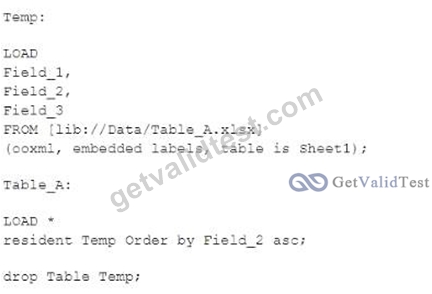
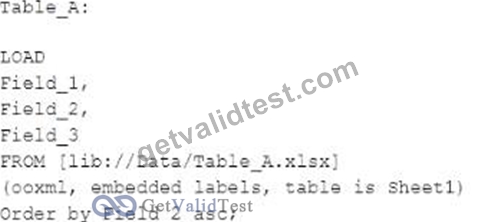
A data architect needs to load Table_A from an Excel file and sort the data by Reld_2.
Which script should the data architect use?
- A.
- B.

- C.
- D.
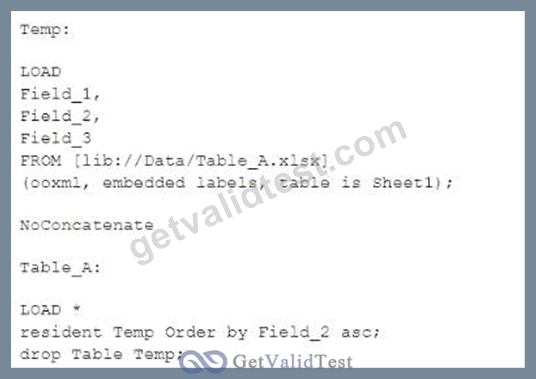
Answer: A
Explanation:
In this scenario, the data architect needs to load Table_A from an Excel file and ensure that the data is sorted by Field_2. The key here is to correctly load and sort the data in the script.
Understanding the Options:
* Option A:
* First, it loads the data into a temporary table (Temp) from the Excel file.
* Then, it loads the data from the temporary table (Temp) into Table_A, using the ORDER BY Field_2 ASC clause to sort the data by Field_2.
* Finally, it drops the temporary table (Temp), leaving the sorted data in Table_A.
* Option B:
* Directly loads the data from the Excel file into Table_A and applies the ORDER BY Field_2 ASC clause in the same step.
* However, the ORDER BY clause in a direct load from an external source like Excel might not work as expected because Qlik Sense does not support ORDER BY when loading directly from a file.
* Option C:
* Similar to Option A but uses the NoConcatenate keyword to prevent concatenation, which is unnecessary since Temp and Table_A have different names.
* While this script works, the NoConcatenate keyword is redundant in this context.
* Option D:
* The ORDER BY Field_2 ASC is placed before the LOAD statement, which is not a correct usage in Qlik Sense script syntax.
Correct Script Choice:
* Option Ais the correct script because it correctly sorts the data after loading it into a temporary table and then loads the sorted data into Table_A. This method ensures that the data is sorted by Field_2 and avoids any issues related to sorting during the initial data load.
References:
* Qlik Sense Scripting Best Practices: When sorting data in Qlik Sense, the correct approach is to use a RESIDENT LOAD with an ORDER BY clause after loading the data into a temporary table.
NEW QUESTION # 23
Exhibit.
Refer to the exhibit.
A data architect wants to transform the input data set to the output data set. Which prefix to the Qlik Sense LOAD command should the data architect use?
- A. PivotTable
- B. Peek
- C. Generic
- D. Hierarchy Be longsTo
Answer: C
Explanation:
In this scenario, the data architect wants to transform the input dataset, which is in a key-value pair structure, into a table where each attribute becomes a column with its corresponding value under the relevant key.
Understanding the Requirement:
* Theinputdata consists of three fields: Key, Attribute, and Value.
* The desiredoutputstructure has the Key as a primary identifier, and the Attributes (like Color, Diameter, Height, etc.) are spread across the columns, with corresponding values filled in each row.
Best Method to Achieve this Transformation:
* The appropriate method to convert key-value pairs into a structured table where each unique attribute becomes a separate column is theGeneric Loadfunction in Qlik Sense.
Why Generic?
* Generic Loadis specifically designed for situations where data is stored in a key-value format (like the one provided) and needs to be converted into a more traditional tabular format, with attributes as columns.
* It creates a separate table for each combination of Key and Attribute, effectively "pivoting" the attribute values into columns in the output table.
How it Works:
* When applying a GENERIC LOAD to the input dataset, Qlik Sense will generate multiple tables, one for each Attribute. However, in the final data model, Qlik Sense automatically joins these tables by the Key field, effectively producing the desired output structure.
References:
* Qlik Sense Documentation on Generic Load: The documentation outlines how to use the Generic Load to handle key-value pairs and pivot them into a more traditional table format.
NEW QUESTION # 24
Exhibit
Refer to the exhibit.
The salesperson ID and the office to which the salesperson belongs is stored for each transaction. The data model also contains the current office for the salesperson. The current office of the salesperson and the office the salesperson was in when the transaction occurred must be visible. The current source table view of the model is shown. A data architect must resolve the synthetic key.
How should the data architect proceed?
- A. Inner Join the Transaction table to the CurrentOffice table
- B. Force concatenation between the tables
- C. Comment out the Office in the Transaction table
- D. Alias Office to CurrentOffice In the CurrentOffice table
Answer: D
Explanation:
In the provided data model, both the CurrentOffice and Transaction tables contain the fields SalesID and Office. This leads to the creation of a synthetic key in Qlik Sense because of the two common fields between the two tables. A synthetic key is created automatically by Qlik Sense when two or more tables have two or more fields in common. While synthetic keys can be useful in some scenarios, they often lead to unwanted and unexpected results, so it's generally advisable to resolve them.
In this case, the goal is to have both the current office of the salesperson and the office where the transaction occurred visible in the data model. Here's how each option compares:
* Option A: Comment out the Office in the Transaction table:This would remove the Office field from the Transaction table, which would prevent you from seeing which office the salesperson was in when the transaction occurred. This option does not meet the requirement.
* Option B: Inner Join the Transaction table to the CurrentOffice table:Performing an inner join would merge the two tables based on the common SalesID and Office fields. However, this might result in a loss of data if there are sales records in the Transaction table that don't have a corresponding record in the CurrentOffice table or vice versa. This approach might also lead to unexpected results in your analysis.
* Option C: Alias Office to CurrentOffice In the CurrentOffice table:By renaming the Office field in the CurrentOffice table to CurrentOffice, you prevent the synthetic key from being created. This allows you to differentiate between the salesperson's current office and the office where the transaction occurred. This approach maintains the integrity of your data and allows for clear analysis.
* Option D: Force concatenation between the tables:Forcing concatenation would combine the rows of both tables into a single table. This would not solve the issue of distinguishing between the current office and the office at the time of the transaction, and it could lead to incorrect data associations.
Given these considerations, the best approach to resolve the synthetic key while fulfilling the requirement of having both the current office and the office at the time of the transaction visible is toAlias Office to CurrentOffice in the CurrentOffice table. This ensures that the data model will accurately represent both pieces of information without causing synthetic key issues.
NEW QUESTION # 25
Refer to the exhibit.
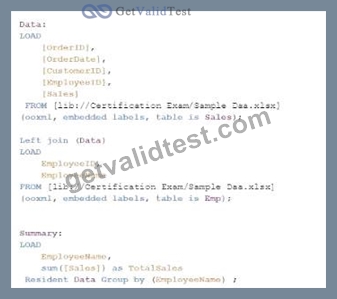
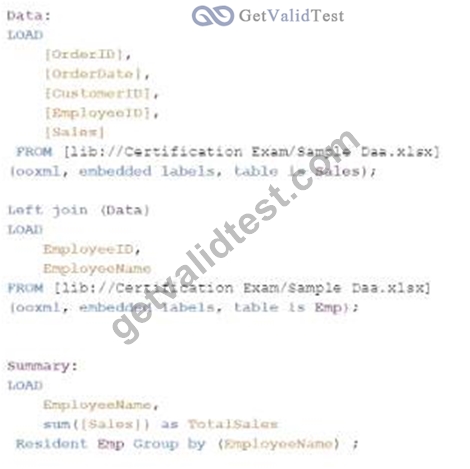
A data architect needs to build a dashboard that displays the aggregated sates for each sales representative. All aggregations on the data must be performed in the script.
Which script should the data architect use to meet these requirements?
- A.
- B.

- C.

- D.
Answer: B
Explanation:
The goal is to display the aggregated sales for each sales representative, with all aggregations being performed in the script. Option C is the correct choice because it performs the aggregation correctly using a Group by clause, ensuring that the sum of sales for each employee is calculated within the script.
* Data Load:
* The Data table is loaded first from the Sales table. This includes the OrderID, OrderDate, CustomerID, EmployeeID, and Sales.
* Next, the Emp table is loaded containing EmployeeID and EmployeeName.
* Joining Data:
* A Left Join is performed between the Data table and the Emp table on EmployeeID, enriching the data with EmployeeName.
* Aggregation:
* The Summary table is created by loading the EmployeeName and calculating the total sales using the sum([Sales]) function.
* The Resident keyword indicates that the data is pulled from the existing tables in memory, specifically the Data table.
* The Group by clause ensures that the aggregation is performed correctly for each EmployeeName, summarizing the total sales for each employee.
Key Qlik Sense Data Architect References:
* Resident Load: This is a method to reuse data that is already loaded into the app's memory. By using a Resident load, you can create new tables or perform calculations like aggregation on the existing data.
* Group by Clause: The Group by clause is essential when performing aggregations in the script. It groups the data by specified fields and performs the desired aggregation function (e.g., sum, count).
* Left Join: Used to combine data from two tables. In this case, Left Join is used to enrich the sales data with employee names, ensuring that the sales data is associated correctly with the respective employee.
Conclusion:Option C is the most appropriate script for this task because it correctly performs the necessary joins and aggregations in the script. This ensures that the dashboard will display the correct aggregated sales per employee, meeting the data architect's requirements.
NEW QUESTION # 26
Exhibit.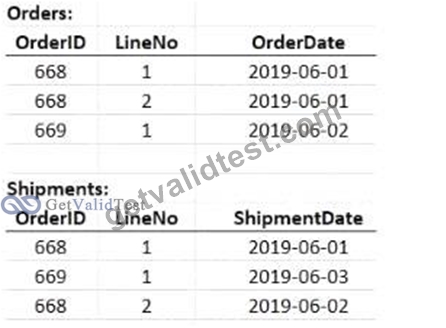
Refer to the exhibit.
A data architect is loading the tables and a synthetic key is generated.
How should the data architect resolve the synthetic key?
- A. Remove the LineNo field from Shipments and use the AutoNumber function on the OrderlD field
- B. Create a composite key using OrderlD and LineNo, and remove OrderlD and LineNo from Shipments
- C. Remove the LineNo field from both tables and use the AutoNumber function on the OrderlD field
- D. Create a composite key using OrderlD and UneNo
Answer: D
Explanation:
In this scenario, the data architect is loading two tables, Orders and Shipments, into Qlik Sense, and a synthetic key is being generated due to the presence of shared fields (OrderID and LineNo) between these tables.
Understanding the Issue:
* Synthetic Keys: Qlik Sense automatically creates synthetic keys when two or more tables share multiple fields with the same names. While synthetic keys aren't necessarily problematic, they can sometimes lead to incorrect or unexpected data associations and should be resolved when possible to maintain clarity and control over the data model.
* The tables Orders and Shipments share the fields OrderID and LineNo. In this context, these fields together uniquely identify each record, so they are both necessary for accurate data linkage.
Correct Resolution Approach:
Option C: Create a composite key using OrderID and LineNois the best approach.
Here's why:
* Composite Key Creation:
* By creating a composite key that combines OrderID and LineNo (e.g., OrderID & '-' & LineNo), you ensure that each line in the orders and shipments tables is uniquely identified. This composite key will accurately link the related records from the Orders and Shipments tables.
* Avoiding Synthetic Keys:
* By manually creating this composite key, you eliminate the need for Qlik Sense to generate a synthetic key, thereby simplifying the data model and ensuring that data associations are clear and controlled.
* Retaining Both Fields:
* This approach allows you to keep both OrderID and LineNo as separate fields in your tables if needed for other analyses or reporting purposes, while using the composite key for linking the tables.
References:
* Qlik Sense Data Modeling Best Practices: When dealing with multiple fields that are used together to uniquely identify records, it is recommended to create composite keys rather than relying on Qlik Sense's synthetic keys for clarity and better control.
NEW QUESTION # 27
Exhibit.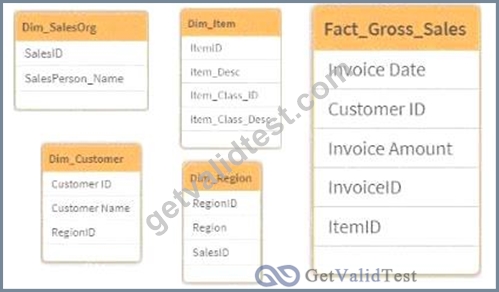
Refer to the exhibit.
A data architect is provided with five tables. One table has Sales Information. The other four tables provide attributes that the end user will group and filter by.
There is only one Sales Person in each Region and only one Region per Customer.
Which data model is the most optimal for use in this situation?
- A.

- B.
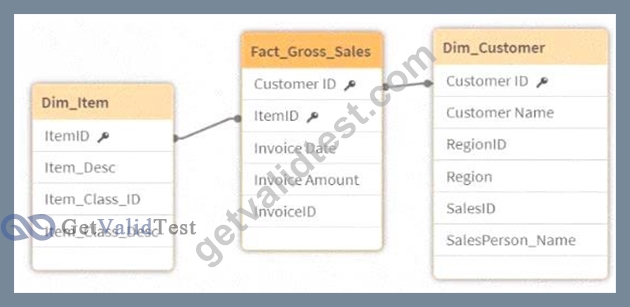
- C.

- D.
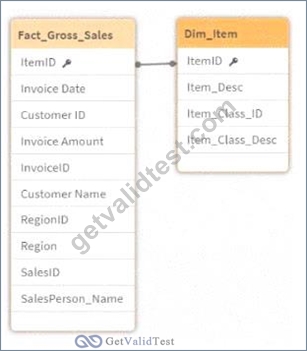
Answer: C
Explanation:
In the given scenario, where the data architect is provided with five tables, the goal is to design the most optimal data model for use in Qlik Sense. The key considerations here are to ensure a proper star schema, minimize redundancy, and ensure clear and efficient relationships among the tables.
Option Dis the most optimal model for the following reasons:
* Star Schema Design:
* In Option D, the Fact_Gross_Sales table is clearly defined as the central fact table, while the other tables (Dim_SalesOrg, Dim_Item, Dim_Region, Dim_Customer) serve as dimension tables.
This layout adheres to the star schema model, which is generally recommended in Qlik Sense for performance and simplicity.
* Minimization of Redundancies:
* In this model, each dimension table is only connected directly to the fact table, and there are no unnecessary joins between dimension tables. This minimizes the chances of redundant data and ensures that each dimension is only represented once, linked through a unique key to the fact table.
* Clear and Efficient Relationships:
* Option D ensures that there is no ambiguity in the relationships between tables. Each key field (like Customer ID, SalesID, RegionID, ItemID) is clearly linked between the dimension and fact tables, making it easy for Qlik Sense to optimize queries and for users to perform accurate aggregations and analysis.
* Hierarchical Relationships and Data Integrity:
* This model effectively represents the hierarchical relationships inherent in the data. For example, each customer belongs to a region, each salesperson is associated with a sales organization, and each sales transaction involves an item. By structuring the data in this way, Option D maintains the integrity of these relationships.
* Flexibility for Analysis:
* The model allows users to group and filter data efficiently by different attributes (such as salesperson, region, customer, and item). Because the dimensions are not interlinked directly with each other but only through the fact table, this setup allows for more flexibility in creating visualizations and filtering data in Qlik Sense.
References:
* Qlik Sense Best Practices: Adhering to star schema designs in Qlik Sense helps in simplifying the data model, which is crucial for performance optimization and ease of use.
* Data Modeling Guidelines: The star schema is recommended over snowflake schema for its simplicity and performance benefits in Qlik Sense, particularly in scenarios where clear relationships are essential for the integrity and accuracy of the analysis.
NEW QUESTION # 28
Exhibit.
Refer to the exhibit.
A data architect is loading two tables into a data model from a SQL database. These tables are related on key fields CustomerlD and Customer Key.
Which script should the data architect use?
- A.

- B.

- C.

- D.

Answer: A
Explanation:
In the scenario, two tables (OrderDetails and Customers) are being loaded into the Qlik Sense data model, and these tables are related via the fields CustomerID and CustomerKey. The goal is to ensure that the relationship between these two tables is correctly established in Qlik Sense without creating synthetic keys or data inconsistencies.
* Option A:Renaming CustomerKey to CustomerID in the OrderDetails table ensures that the fields will have the same name across both tables, which is necessary to create the relationship. However, renaming is done using AS, which might create an issue if the fields in the original data source have a different meaning.
* Option B and C:These options use AUTONUMBER to convert the CustomerKey and CustomerID to unique numeric values. However, using AUTONUMBER for both fields without ensuring they are aligned correctly might lead to incorrect associations since AUTONUMBER generates unique values based on the order of data loading, and these might not match across tables.
* Option D:This approach loads the tables with their original field names and then uses the RENAME FIELD statement to align the field names (CustomerKey to CustomerID). This ensures that the key fields are correctly aligned across both tables, maintaining their relationship without introducing synthetic keys or mismatches.
NEW QUESTION # 29 
Refer to the exhibit.
A data architect needs to load data from Customers.qvd and sort the Country field in ascending order. Which method should be used?
- A. Move the Country field to the first position in the field list in the LOAD statement
- B. Insert an Order By clause after the FROM clause in the CustTemp table
- C. Perform a Resident LOAD of the CustTemp table and insert an Order By clause in this table
- D. Insert a Group By clause into the LOAD statement for the CustTemp table after the FROM clause
Answer: C
Explanation:
When loading data from a QVD file into a Qlik Sense application, if you need to sort the data by a specific field (in this case, the Country field), the Order By clause can be used. However, the Order By clause cannot be directly applied during the initial load from the QVD. Instead, the data should first be loaded into a temporary table and then sorted in a subsequent resident load.
* Initial Load from QVD:The data is first loaded into a temporary table (CustTemp) without any sorting.
* Resident Load with Order By:After the initial load, you perform a Resident Load from the CustTemp table and apply the Order By clause to sort the data by the Country field in ascending order.
LOAD
Address,
City,
CompanyName,
ContactName,
Country,
_CustomerID,
DivisionID,
DivisionName,
Fax,
Phone,
PostalCode,
StateProvince
RESIDENT CustTemp
ORDER BY Country;
This method ensures that the data is sorted correctly without violating Qlik Sense's loading rules.
NEW QUESTION # 30
A data architect needs to upload data from ten different sources, but only if there are any changes after the last reload. When data is updated, a new file is placed into a folder mapped to E:\486396169. The data connection points to this folder.
The data architect plans a script which will:
1. Verify that the file exists
2. If the file exists, upload it Otherwise, skip to the next piece of code.
The script will repeat this subroutine for each source. When the script ends, all uploaded files will be removed with a batch procedure. Which option should the data architect use to meet these requirements?
- A. FileSize, IF, THEN, END IF
- B. FileExists, FOR EACH, IF
- C. FilePath, FOR EACH, Peek, Drop
- D. FilePath, IF, THEN, Drop
Answer: B
Explanation:
In this scenario, the data architect needs to verify the existence of files before attempting to load them and then proceed accordingly. The correct approach involves using the FileExists() function to check for the presence of each file. If the file exists, the script should execute the file loading routine. The FOR EACH loop will handle multiple files, and the IF statement will control the conditional loading.
* FileExists(): This function checks whether a specific file exists at the specified path. If the file exists, it returns TRUE, allowing the script to proceed with loading the file.
* FOR EACH: This loop iterates over a list of items (in this case, file paths) and executes the enclosed code for each item.
* IF: This statement checks the condition returned by FileExists(). If TRUE, it executes the code block for loading the file; otherwise, it skips to the next iteration.
This combination ensures that the script loads data only if the files are present, optimizing the data loading process and preventing unnecessary errors.
NEW QUESTION # 31 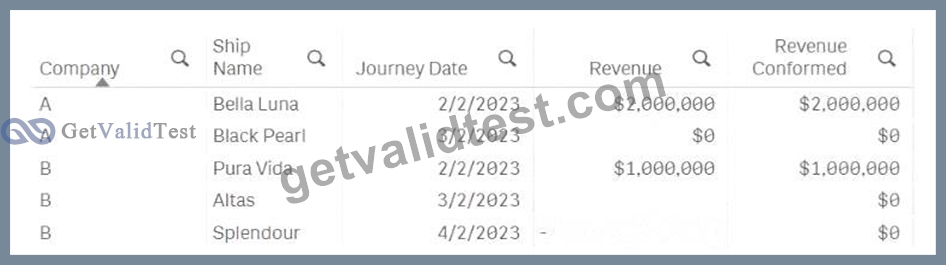
Refer to the exhibit
A large transport company (Company A) acquires a smaller rival (Company B).
Company A has been using Qlik Sense tor 6 years to track revenue per ship journey. Ship journeys with no revenue (such as journeys to shipyards for repair) always show revenue of $0.
Company A wants to combine its data set with the data set of the acquired Company B. Company B's ship journey data shows $0 revenue in one of the following ways:
* A NULL value
* A value with one or more blank spaces (ASCII char code 32)
The data architect wants to conform the Company B data to the Company A standard, specifically regarding the use of an explicit $0 for journeys without revenue. Which script line should the data architect use?
- A.

- B.

- C.

- D.

Answer: D
Explanation:
In this scenario, the data architect needs to conform the revenue data from Company B to match the data standard of Company A, where $0 is explicitly used to represent journeys without revenue.
Explanation of the Correct Script:
* Option A:money(replace(Revenue, chr(32), 0)) AS [Revenue Conformed]
* replace(Revenue, chr(32), 0):This part of the expression replaces any spaces (ASCII character code 32) in the Revenue field with 0.
* money(...):This function formats the resulting value as currency. Since Company B may have either null values or spaces where 0 should be, this script ensures that any blanks are replaced with 0 and then formatted as currency.
Why Option A is Correct:
* Handling Spaces:The replace() function is effective in replacing spaces with 0, conforming to Company A's standard of using $0 for non-revenue journeys.
* Handling NULL Values:The money() function is used to ensure the final output is formatted as currency. However, it's important to note that NULL values are not directly handled by the replace() function, which is why it is applied before money() to deal with spaces.
NEW QUESTION # 32
......
QSDA2024 Question Bank: Free PDF Download Recently Updated Questions: https://braindumps.getvalidtest.com/QSDA2024-brain-dumps.html