


Get New 2026 Fortinet exam NSE8_812 Dumps Bundle On flat Updated Dumps!
Full NSE8_812 Practice Test and 107 unique questions with explanations waiting just for you, get it now!
NEW QUESTION # 22
Review the following FortiGate-6000 configuration excerpt:
Based on the configuration, which statement is correct regarding SNAT source port partitioning behavior?
- A. It dynamically distributes SNAT source ports to operating FPCs or FPMs.
- B. It equally distributes SNAT source ports across chassis slots.
- C. It is the default SNAT configuration and preserves active sessions when an FPC or FPM goes down.
- D. It statically distributes SNAT source ports to operating FPCs or FPMs
Answer: D
Explanation:
https://docs.fortinet.com/document/fortigate/7.4.1/fortigate-6000-administration-guide/81276/controlling-snat- port-partitioning-behavior
"chassis-slots this option statically allocates SNAT source ports to all FPCs that are enabled when you enter the command. If you disable an FPC from the CLI, the SNAT source ports assigned to that FPC will not be re- allocated to the remaining FPCs. All FPCs that are still operating will maintain the same SNAT source port allocation and active sessions being processed by the still operating FPCs will not be affected."
NEW QUESTION # 23
Refer to the exhibits.
The exhibits show a diagram of a requested topology and the base IPsec configuration.
A customer asks you to configure ADVPN via two internet underlays. The requirement is that you use one interface with a single IP address on DC FortiGate.
In this scenario, which feature should be implemented to achieve this requirement?
- A. Change advpn2 to IKEv1
- B. Use local-id
- C. Use network-overlay id
- D. Use peer-id
Answer: C
Explanation:
A is correct because using network-overlay id allows you to configure multiple ADVPN tunnels on a single interface with a single IP address on the DC FortiGate. This is explained in the FortiGate Administration Guide under ADVPN > Configuring ADVPN > Configuring ADVPN on the hub. Reference: https://docs.fortinet.com/document/fortigate/7.4.0/administration-guide/978793/advpn https://docs.fortinet.com/document/fortigate/7.4.0/administration-guide/978793/advpn/978794/configuring-advpn
NEW QUESTION # 24
Refer to the exhibit, which shows a multi-region SD-WAN architecture.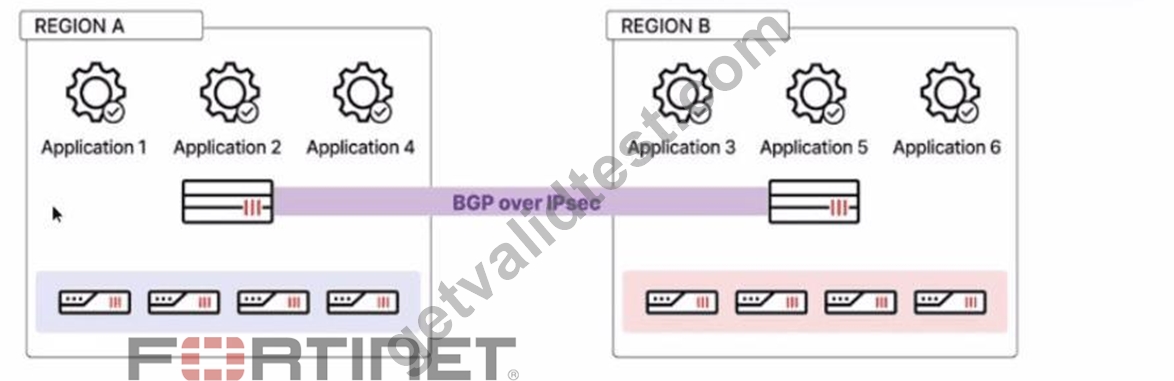
Given this scenario, which two statements are true? (Choose two.)
- A. If eBGP is used, ADVPN can be established for branch-to-branch traffic across regions.
- B. If iBGP is used, cross-regional spoke-to-hub shortcuts cannot be used.
- C. If eBGP is used, ADVPN can be established only for branch-to-branch traffic within each region.
- D. If iBGP is used, cross-regional spoke-to-hub shortcuts can be established.
Answer: C
NEW QUESTION # 25
Which two methods are supported for importing user defined Lookup Table Data into the FortiSIEM? (Choose two.)
- A. API
- B. SCP
- C. FTP
- D. Report
Answer: A,D
Explanation:
FortiSIEM supports two methods for importing user defined Lookup Table Data:
Report: You can import lookup table data from a report. This is the most common method for importing lookup table data.
API: You can also import lookup table data using the FortiSIEM API. This is a more advanced method that allows you to import lookup table data programmatically.
FTP, SCP, and other file transfer protocols are not supported for importing lookup table data into FortiSIEM.
NEW QUESTION # 26
You must configure an environment with dual-homed servers connected to a pair of FortiSwitch units using an MCLAG.
Multicast traffic is expected in this environment, and you should ensure unnecessary traffic is pruned from links that do not have a multicast listener.
In which two ways must you configure the igmps-f lood-traffic and igmps-flood-report settings? (Choose two.)
- A. disable on ICL trunks
- B. disable on the ISL and FortiLink trunks
- C. enable on ICL trunks
- D. enable on the ISL and FortiLink trunks
Answer: A,B
Explanation:
A is correct because disabling igmps-flood-traffic and igmps-flood-report on ICL trunks prevents unnecessary multicast traffic from being flooded across the MCLAG cluster members. C is correct because disabling igmps-flood-traffic and igmps-flood-report on the ISL and FortiLink trunks prevents unnecessary multicast traffic from being flooded to other switches or FortiGates that do not have multicast listeners. Reference: https://docs.fortinet.com/document/fortiswitches/6.4.0/administration-guide/381057/multicast-forwarding https://docs.fortinet.com/document/fortiswitches/6.4.0/administration-guide/381057/multicast-forwarding/381058/configuring-multicast-forwarding
NEW QUESTION # 27
Refer to the exhibits.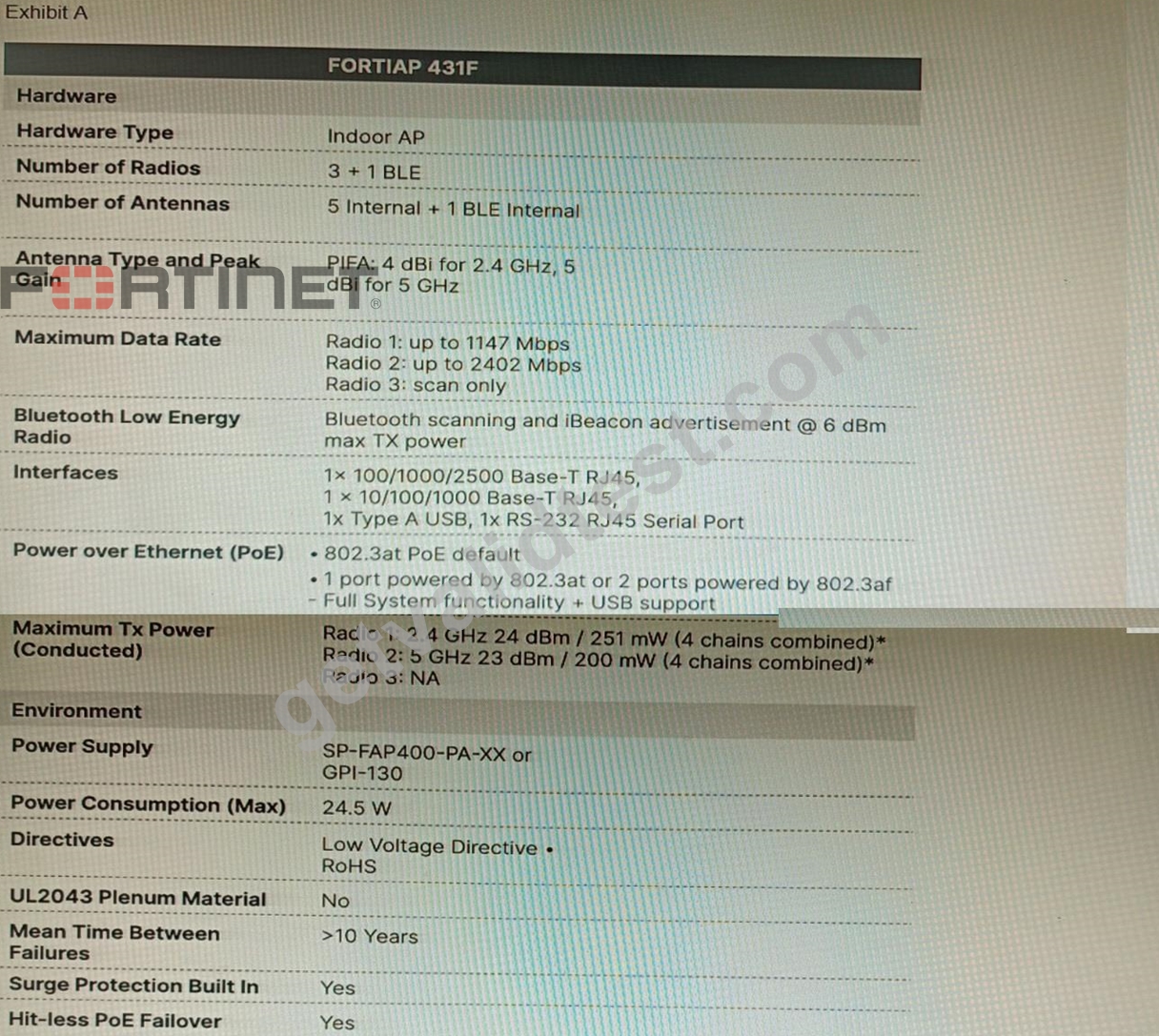

A customer wants to deploy 12 FortiAP 431F devices on high density conference center, but they do not currently have any PoE switches to connect them to. They want to be able to run them at full power while having network redundancy From the FortiSwitch models and sample retail prices shown in the exhibit, which build of materials would have the lowest cost, while fulfilling the customer's requirements?
- A. 2x FortiSwitch 224E-POE
- B. 2x FortiSwitch 248E-FPOE
- C. 2x FortiSwitch 124E-FPOE
- D. 1x FortiSwitch 248EFPOE
Answer: C
Explanation:
the access point will require about 24.5 W of power and the 124E-FPOE has a Capacity of about 370 meaning
25x12 = 300 so you left with about 70 W on the switch meaning you can still add two more access point on that switch.
NEW QUESTION # 28
A customer's cybersecurity department needs to implement security for the traffic between two VPCs in AWS, but these belong to different departments within the company. The company uses a single region for all their VPCs.
Which two actions will achieve this requirement while keeping separate management of each department's VPC? (Choose two.)
- A. Create an 1AM account for the cybersecurity department to manage both existing VPC, create a FortiGate HA Cluster on each VPC and IPSEC VPN to force traffic between the VPCs through the FortiGate clusters
- B. Create a transit VPC with a FortiGate HA cluster, connect to the other two using VPC peering, and use routing tables to force traffic through the FortiGate cluster.
- C. Create a VPC with a FortiGate auto-scaling group with a Transit Gateway attached to the three VPC to force routing through the FortiGate cluster
- D. Migrate all the instances to the same VPC and create 1AM accounts for each department, then implement a new subnet for a FortiGate auto-scaling group and use routing tables to force the traffic through the FortiGate cluster.
Answer: B,C
Explanation:
To implement security for the traffic between two VPCs in AWS, while keeping separate management of each department's VPC, two possible actions are:
* Create a transit VPC with a FortiGate HA cluster, connect to the other two using VPC peering, and use routing tables to force traffic through the FortiGate cluster. This option allows the cybersecurity department to manage the transit VPC and apply security policies on the FortiGate cluster, while the other departments can manage their own VPCs and instances. The VPC peering connections enable direct communication between the VPCs without using public IPs or gateways. The routing tables can be configured to direct all inter-VPC traffic to the transit VPC.
* Create a VPC with a FortiGate auto-scaling group with a Transit Gateway attached to the three VPCs to force routing through the FortiGate cluster. This option also allows the cybersecurity department to manage the security VPC and apply security policies on the FortiGate cluster, while the other departments can manage their own VPCs and instances. The Transit Gateway acts as a network hub that connects multiple VPCs and on-premises networks. The routing tables can be configured to direct all inter-VPC traffic to the security VPC. References: https://docs.fortinet.com/document/fortigate-public- cloud/7.2.0/aws-administration-guide/506140/connecting-a-local-fortigate-to-an-aws-vpc-vpn
https://docs.fortinet.com/document/fortigate-public-cloud/7.0.0/sd-wan-architecture-for-enterprise
/166334/sd-wan-configuration
NEW QUESTION # 29
You must configure an environment with dual-homed servers connected to a pair of FortiSwitch units using an MCLAG.
Multicast traffic is expected in this environment, and you should ensure unnecessary traffic is pruned from links that do not have a multicast listener.
In which two ways must you configure the igmps-f lood-traffic and igmps-flood-report settings? (Choose two.)
- A. disable on the ISL and FortiLink trunks
- B. disable on ICL trunks
- C. enable on ICL trunks
- D. enable on the ISL and FortiLink trunks
Answer: B,D
Explanation:
To ensure that unnecessary multicast traffic is pruned from links that do not have a multicast listener, you must disable IGMP flood traffic on the ICL trunks and enable IGMP flood reports on the ISL and FortiLink trunks.
Disabling IGMP flood traffic will prevent the FortiSwitch units from flooding multicast traffic to all ports on the ICL trunks. This will help to reduce unnecessary multicast traffic on the network.
Enabling IGMP flood reports will allow the FortiSwitch units to learn which ports are interested in receiving multicast traffic. This will help the FortiSwitch units to prune multicast traffic from links that do not have a multicast listener.
NEW QUESTION # 30
Refer to the exhibits, which show a firewall policy configuration and a network topology.
An administrator has configured an inbound SSL inspection profile on a FortiGate device (FG-1) that is protecting a data center hosting multiple web pages-Given the scenario shown in the exhibits, which certificate will FortiGate use to handle requests to xyz.com?
- A. FortiGate will use the first certificate in the server-cert list-the abc.com certificate
- B. FortiGate will reject the connection since no certificate is defined.
- C. FortiGate will use the Fortinet_CA_Untrusted certificate for the untrusted connection,
- D. FortiGate will fall-back to the default Fortinet_CA_SSL certificate.
Answer: D
Explanation:
When using inbound SSL inspection, FortiGate needs to present a certificate to the client that matches the requested domain name. If no matching certificate is found in the server-cert list, FortiGate will fall-back to the default Fortinet_CA_SSL certificate, which is self-signed and may trigger a warning on the client browser. References: https://docs.fortinet.com/document/fortigate/6.4.0/cookbook/103437/inbound-ssl-inspection
NEW QUESTION # 31
Refer to the exhibit.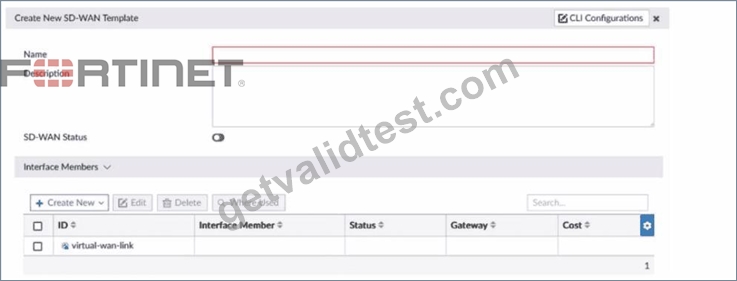
You need to create a base SD-WAN configuration that includes SD-WAN rules and Performance SLAs for spoke sites with various connectivity types. It needs to be done in a way that can be easily applied to new sites with a minimum amount of change. How should you create the SD-WAN zones?
- A. With members and assign interfaces but do not specify a gateway
- B. With members without interface assignments
- C. With members and assign overlay interfaces
- D. With no members configured
Answer: C
NEW QUESTION # 32
An administrator has configured a FortiGate device to authenticate SSL VPN users using digital certificates. A FortiAuthenticator is the certificate authority (CA) and the Online Certificate Status Protocol (OCSP) server.
Part of the FortiGate configuration is shown below:
Based on this configuration, which two statements are true? (Choose two.)
- A. OCSP certificate responses are never cached by the FortiGate.
- B. OCSP checks will always go to the configured FortiAuthenticator
- C. If the OCSP server is unreachable, authentication will succeed if the certificate matches the CA.
- D. The OCSP check of the certificate can be combined with a certificate revocation list.
Answer: B,C
Explanation:
A is correct because the OCSP server is configured as the FortiAuthenticator in the config vpn certificate ocsp-server section. D is correct because the config vpn ssl settings section has set ocsp-option to allow. This means that if the OCSP server is unreachable, authentication will succeed if the certificate matches the CA. Reference: https://docs.fortinet.com/document/fortigate/7.0.1/administration-guide/490351/ssl-vpn-authentication https://docs.fortinet.com/document/fortigate/7.4.0/administration-guide/266506/ssl-vpn-with-certificate-authentication
NEW QUESTION # 33
You are deploying a FortiExtender (FEX) on a FortiGate-60F. The FEX will be managed by the FortiGate. You anticipate high utilization. The requirement is to minimize the overhead on the device for WAN traffic.
Which action achieves the requirement in this scenario?
- A. Add a switch between the FortiGate and FEX.
- B. Change connectivity between the FortiGate and the FortiExtender to use VLAN Mode
- C. Enable CAPWAP connectivity between the FortiGate and the FortiExtender.
- D. Add a VLAN under the FEX-WAN interface on the FortiGate.
Answer: B
Explanation:
VLAN Mode is a more efficient way to connect a FortiExtender to a FortiGate than CAPWAP Mode. This is because VLAN Mode does not require the FortiExtender to send additional control traffic to the FortiGate.
The other options are not correct.
a) Add a switch between the FortiGate and FEX. This will add overhead to the network, as the switch will need to process the traffic.
b) Enable CAPWAP connectivity between the FortiGate and the FortiExtender. This will increase the overhead on the FortiGate, as it will need to process additional control traffic.
d) Add a VLAN under the FEX-WAN interface on the FortiGate. This will not affect the overhead on the FortiGate.
NEW QUESTION # 34
Refer to the exhibit.
Given the exhibit, which two statements about FortiGate FGSP HA cluster behavior are correct? (Choose two.)
- A. You can selectively synchronize only specific sessions between FGSP cluster members.
- B. Cluster members will upgrade one at a time and failover during firmware upgrades.
- C. Session synchronization occurs over Layer 3 by default, and if unavailable it will then try Layer 2.
- D. You can run FortiGate Virtual Router Redundancy Protocol (VRRP) high availability in addition to FGSP simultaneously.
Answer: C,D
NEW QUESTION # 35
Refer to the exhibit.
You are deploying a FortiGate 6000F. The device should be directly connected to a switch. In the future, a new hardware module providing higher speed will be installed in the switch, and the connection to the FortiGate must be moved to this higher-speed port.
You must ensure that the initial FortiGate interface connected to the switch does not affect any other port when the new module is installed and the new port speed is defined.
How should the initial connection be made?
- A. Connect the switch on any interface between ports 5 to 8.
- B. Connect the switch on any interface between ports 25 to 28
- C. Connect the switch on any interface between ports 21 to 24
- D. Connect the switch on any interface between ports 1 to 4
Answer: B
NEW QUESTION # 36
Refer to the exhibit.
A FortiWeb appliance is configured for load balancing web sessions to internal web servers. The Server Pool is configured as shown in the exhibit.
How will the sessions be load balanced between server 1 and server 2 during normal operation?
- A. Server 1 will receive 25% of the sessions, Server 2 will receive 75% of the sessions
- B. Server 1 will receive 0% of the sessions Server 2 will receive 100% of the sessions
- C. Server 1 will receive 20% of the sessions, Server 2 will receive 66.6% of the sessions
- D. Server 1 will receive 33.3% of the sessions, Server 2 will receive 66 6% of the sessions
Answer: B
Explanation:
D is correct because server 1 has a weight of 0, which means it will not receive any sessions from the load balancer. Server 2 has a weight of 100, which means it will receive all sessions from the load balancer. This is explained in the FortiWeb Administration Guide under Server Load Balancing > Server pools > Weighted round robin. Reference: https://docs.fortinet.com/document/fortiweb/6.3.0/administration-guide/381057/server-load-balancing https://docs.fortinet.com/document/fortiweb/6.3.0/administration-guide/381057/server-load-balancing/381058/server-pools
NEW QUESTION # 37
Refer to the exhibit.
You have deployed a security fabric with three FortiGate devices as shown in the exhibit. FGT_2 has the following configuration: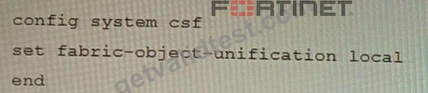
FGT_1 and FGT_3 are configured with the default setting. Which statement is true for the synchronization of fabric-objects?
- A. Objects from the root FortiGate will not be synchronized to any downstream FortiGate.
- B. Objects from the root FortiGate will only be synchronized to FGT__2.
- C. Objects from the FortiGate FGT_2 will be synchronized to the upstream FortiGate.
- D. Objects from the root FortiGate will only be synchronized to FGT_3.
Answer: A
Explanation:
The fabric-object-unification setting on FGT_2 is set to local, which means that objects will not be synchronized to any other FortiGate devices in the security fabric. The default setting for fabric-object-unification is default, which means that objects will be synchronized from the root FortiGate to all downstream FortiGate devices.
Since FGT_2 is not the root FortiGate and the fabric-object-unification setting is set to local, objects from the root FortiGate will not be synchronized to FGT_2.
Reference:
Synchronizing objects across the Security Fabric: https://docs.fortinet.com/document/fortigate/6.4.0/administration-guide/880913/synchronizing-objects-across-the-security-fabric
NEW QUESTION # 38
SD-WAN is configured on a FortiGate. You notice that when one of the internet links has high latency the time to resolve names using DNS from FortiGate is very high.
You must ensure that the FortiGate DNS resolution times are as low as possible with the least amount of work.
What should you configure?
- A. Configure two DNS servers and use DNS servers recommended by the two internet providers.
- B. Configure an SD-WAN rule to the DNS server and use the FortiGate interface IPs in the source address.
- C. Configure local out traffic to use the outgoing interface based on SD-WAN rules with the interface IP and configure an SD-WAN rule to the DNS server.
- D. Configure local out traffic to use the outgoing interface based on SD-WAN rules with a manual defined IP associated to a loopback interface and configure an SD-WAN rule from the loopback to the DNS server.
Answer: C
Explanation:
SD-WAN is a feature that allows users to optimize network performance and reliability by using multiple WAN links and applying rules based on various criteria, such as latency, jitter, packet loss, etc. One way to ensure that the FortiGate DNS resolution times are as low as possible with the least amount of work is to configure local out traffic to use the outgoing interface based on SD-WAN rules with the interface IP and configure an SD-WAN rule to the DNS server. This means that the FortiGate will use the best WAN link available to send DNS queries to the DNS server according to the SD-WAN rule, and use its own interface IP as the source address. This avoids NAT issues and ensures optimal DNS performance. References:
https://docs.fortinet.com/document/fortigate/7.0.0/sd-wan/19662/sd-wan
NEW QUESTION # 39
Refer to the exhibit.
A customer reports that they are not able to reach subnet 10.10.10.0/24 from their FortiGate device.
Based on the exhibit, what should you do to correct the situation?
- A. Enable additional-path feature
- B. Enable recursive resolution for BGP routes
- C. Enable next-hop-self feature
- D. Enable iBGP multipath
Answer: C
NEW QUESTION # 40
Refer to the exhibits.
During the implementation of a Fortinet Security Fabric configuration, CLI commands were issued in the order shown in the exhibit. On the next day, the local admin for FGTC issues the following command:
FGTC # config system csf
set configuration-sync default
end
In this scenario, which outcome is true regarding the "subnet_1" firewall address object on FGTC?
- A. The object needs to be recreated on FGTA-1 before it is automatically created on FGTC.
- B. The object will only be automatically created on FGTC if it is modified on FGTA-1.
- C. The object is not automatically created.
- D. The object is automatically created.
Answer: D
NEW QUESTION # 41
Refer to the exhibit.
Given the exhibit, which two statements about FortiGate FGSP HA cluster behavior are correct? (Choose two.)
- A. You can selectively synchronize only specific sessions between FGSP cluster members.
- B. Cluster members will upgrade one at a time and failover during firmware upgrades.
- C. Session synchronization occurs over Layer 3 by default, and if unavailable it will then try Layer 2.
- D. You can run FortiGate Virtual Router Redundancy Protocol (VRRP) high availability in addition to FGSP simultaneously.
Answer: C,D
NEW QUESTION # 42
......
Reduce Your Chance of Failure in NSE8_812 Exam: https://braindumps.getvalidtest.com/NSE8_812-brain-dumps.html