If you think that you have enough time to prepare your Sun Certified Web Component Developer for J2EE 5 actual test, we will provide you with the latest study materials so that you can clear Sun Certified Web Component Developer for J2EE 5 valid test with full confidence. Our website has focused on providing our candidates with the most reliable SUN braindumps torrent with the best quality service. We are here to offer you instant help so that you can get high scores in the 310-083 valid test. Our latest training materials and test questions will surely give you all want for Sun Certified Web Component Developer for J2EE 5 pass test guaranteed. Many candidates realized that it is exhausted thing to join the classes and prefer to choose our Sun Certified Web Component Developer for J2EE 5 exam braindumps as their prior pass guide. Our SCWCD test questions and answers are the best learning materials for preparing their certification.

You must be heard that our latest 310-083 test answers can ensure candidates clear exam with 100% and covers everything you want to solve the difficulties of Sun Certified Web Component Developer for J2EE 5 test questions. All study materials are concluded and tested by our team of IT experts who are specialized in Sun Certified Web Component Developer for J2EE 5 valid dumps. We always keep the updating of our study materials so that our candidates get high marks in the SUN actual test with great confidence. Besides, there are free demo you can download to check the accuracy of Sun Certified Web Component Developer for J2EE 5 test answers.
There are three versions for the preparation of your Sun Certified Web Component Developer for J2EE 5 braindumps torrent. One is Pdf version that can be printable and shared your Sun Certified Web Component Developer for J2EE 5 test questions with your friends. The test engine and online test engine is exam simulation that bring you feel the atmosphere of 310-083 valid test. Online version allows you practice your questions in any electronic equipment without limitation. You can check the test result of Sun Certified Web Component Developer for J2EE 5 exam braindumps after test.
Our aim is offering our customer the most accurate Sun Certified Web Component Developer for J2EE 5 exam braindumps and the most comprehensive service, that's our key of success. You will enjoy one-year free update once you purchased our Sun Certified Web Component Developer for J2EE 5 valid dumps. And once we have any updating about 310-083 test answers, we will send it to your email immediately. Besides, we promise you full refund if you failed exam with our Sun Certified Web Component Developer for J2EE 5 pass test guaranteed materials. Please feel free to contact us if you have any questions.
After purchase, Instant Download: Upon successful payment, Our systems will automatically send the product you have purchased to your mailbox by email. (If not received within 12 hours, please contact us. Note: don't forget to check your spam.)
SUN 310-083 Exam Syllabus Topics:
| Section | Objectives |
|---|---|
| Topic 1: Building a Custom Tag Library | - Custom Tags in JSP Pages |
| Topic 2: The JavaServer Pages (JSP) Technology Model | - JavaServer Pages Technology |
| Topic 3: Session Management | - Java Servlet Technology - JavaServer Pages Technology - Getting Started with Web Applications |
| Topic 4: The Web Container Model | - Java Servlet Technology - Getting Started with Web Applications |
| Topic 5: The Structure and Deployment of Web Applications | - Getting Started with Web Applications |
| Topic 6: Web Application Security | - Securing Web Applications |
| Topic 7: Building JSP Pages Using Tag Libraries | - JavaServer Pages Standard Tag Library |
| Topic 8: Building JSP Pages Using Standard Actions | - JavaServer Pages Technology |
| Topic 9: The Servlet Technology Model | - Java Servlet Technology |
SUN Sun Certified Web Component Developer for J2EE 5 Sample Questions:
Question 1
If you want to use the Java EE platform's built-in type of authentication that uses a custom
HTML page for authentication, which two statements are true? (Choose two.)
A. In the HTML related to authentication for this application, you must use predefined variable names for the variables that store the user and password values.
B. You must have a tag in your deployment descriptor that allows you to point to both a login HTML page and an HTML page for handling any login errors.
C. Your deployment descriptor will need to contain this tag:
< auth-method>CUSTOM</auth-method>.
D. When you use this type of authentication, SSL is turned on automatically.
E. The related custom HTML login page must be named loginPage.html.
Question 2
Click the Exhibit button.
Assume the product attribute does NOT yet exist in any scope.
Which two create an instance of com.example.Product and initialize the name and price properties to the name and price request parameters? (Choose two.)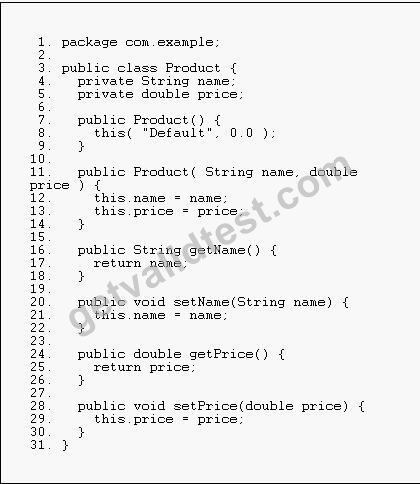
A. <jsp:useBean id="product" class="com.example.Product" />
< jsp:setProperty name="product" property="name"
value="${param.name}" />
< jsp:setProperty name="product" property="price"
value="${param.price}" />
B. <jsp:useBean id="product" class="com.example.Product">
< jsp:setProperty name="product" property="name"
value="${name}" />
< jsp:setProperty name="product" property="price"
value="${price}" />
< /jsp:useBean>
C. <jsp:useBean id="product" class="com.example.Product" />
< jsp:setProperty name="product" property="*" />
D. <jsp:useBean id="product" class="com.example.Product" />
< % product.setName( request.getParameter( "name" ) ); %>
< % product.setPrice( request.getParameter( "price" ) ); %>
Question 3
Given the two security constraints in a deployment descriptor:
1 01. <security-constraint>
1 02. <!--a correct url-pattern and http-method goes here-->
1 03. <auth-constraint><role-name>SALES</role-name></auth-
1 03. <auth-constraint>
1 04. <role-name>SALES</role-name>
1 05. </auth-constraint>
1 06. </security-constraint>
1 07. <security-constraint>
1 08. <!--a correct url-pattern and http-method goes here-->
1 09. <!-- Insert an auth-constraint here -->
1 10. </security-constraint>
If the two security constraints have the same url-pattern and http-method, which two, inserted independently at line 109, will allow users with role names of either SALES or
MARKETING to access this resource? (Choose two.)
A. <auth-constraint/>
B. <auth-constraint>
< role-name>ANY</role-name>
< /auth-constraint>
C. <auth-constraint>
< role-name>MARKETING</role-name>
< /auth-constraint>
D. <auth-constraint>
< role-name>*</role-name>
< /auth-constraint>
Question 4
You need to retrieve the username cookie from an HTTP request. If this cookie does NOT exist, then the c variable will be null. Which code snippet must be used to retrieve this cookie object?
A. 10. Cookie c = null;
1 1. for ( Iterator i = request.getCookies();
1 2. i.hasNext(); ) {
1 3. Cookie o = (Cookie) i.next();
1 4. if ( o.getName().equals("username") ) {
1 5. c = o;
1 6. break;
1 7. }
1 8. }
B. 10. Cookie c = request.getCookie("username");
C. 10. Cookie c = null;
1 1. for ( Enumeration e = request.getCookies();
1 2. e.hasMoreElements(); ) {
1 3. Cookie o = (Cookie) e.nextElement();
1 4. if ( o.getName().equals("username") ) {
1 5. c = o;
1 6. break;
1 7. }
1 8. }
D. 10. Cookie c = null;
1 1. Cookie[] cookies = request.getCookies();
1 2. for ( int i = 0; i < cookies.length; i++ ) {
1 3. if ( cookies[i].getName().equals("username") ) {
1 4. c = cookies[i];
1 5. break;
1 6. }
1 7. }
Question 5
You need to create a servlet filter that stores all request headers to a database for all requests to the web application's home page "/index.jsp". Which HttpServletRequest method allows you to retrieve all of the request headers?
A. java.util.Enumeration getHeaderNames()
B. java.util.Iterator getRequestHeaders()
C. String[] getRequestHeaders()
D. String[] getHeaderNames()
E. java.util.Enumeration getRequestHeaders()
F. java.util.Iterator getHeaderNames()
Solutions:
| Question 1 Answer: A,B | Question 2 Answer: A,C | Question 3 Answer: C,D | Question 4 Answer: D | Question 5 Answer: A |