If you think that you have enough time to prepare your Transition Your MCTS on SQL Server 2008 to MCSA: SQL Server 2012, Part 2 actual test, we will provide you with the latest study materials so that you can clear Transition Your MCTS on SQL Server 2008 to MCSA: SQL Server 2012, Part 2 valid test with full confidence. Our website has focused on providing our candidates with the most reliable Microsoft braindumps torrent with the best quality service. We are here to offer you instant help so that you can get high scores in the 070-458 valid test. Our latest training materials and test questions will surely give you all want for Transition Your MCTS on SQL Server 2008 to MCSA: SQL Server 2012, Part 2 pass test guaranteed. Many candidates realized that it is exhausted thing to join the classes and prefer to choose our Transition Your MCTS on SQL Server 2008 to MCSA: SQL Server 2012, Part 2 exam braindumps as their prior pass guide. Our MCSA test questions and answers are the best learning materials for preparing their certification.

You must be heard that our latest 070-458 test answers can ensure candidates clear exam with 100% and covers everything you want to solve the difficulties of Transition Your MCTS on SQL Server 2008 to MCSA: SQL Server 2012, Part 2 test questions. All study materials are concluded and tested by our team of IT experts who are specialized in Transition Your MCTS on SQL Server 2008 to MCSA: SQL Server 2012, Part 2 valid dumps. We always keep the updating of our study materials so that our candidates get high marks in the Microsoft actual test with great confidence. Besides, there are free demo you can download to check the accuracy of Transition Your MCTS on SQL Server 2008 to MCSA: SQL Server 2012, Part 2 test answers.
There are three versions for the preparation of your Transition Your MCTS on SQL Server 2008 to MCSA: SQL Server 2012, Part 2 braindumps torrent. One is Pdf version that can be printable and shared your Transition Your MCTS on SQL Server 2008 to MCSA: SQL Server 2012, Part 2 test questions with your friends. The test engine and online test engine is exam simulation that bring you feel the atmosphere of 070-458 valid test. Online version allows you practice your questions in any electronic equipment without limitation. You can check the test result of Transition Your MCTS on SQL Server 2008 to MCSA: SQL Server 2012, Part 2 exam braindumps after test.
Our aim is offering our customer the most accurate Transition Your MCTS on SQL Server 2008 to MCSA: SQL Server 2012, Part 2 exam braindumps and the most comprehensive service, that's our key of success. You will enjoy one-year free update once you purchased our Transition Your MCTS on SQL Server 2008 to MCSA: SQL Server 2012, Part 2 valid dumps. And once we have any updating about 070-458 test answers, we will send it to your email immediately. Besides, we promise you full refund if you failed exam with our Transition Your MCTS on SQL Server 2008 to MCSA: SQL Server 2012, Part 2 pass test guaranteed materials. Please feel free to contact us if you have any questions.
After purchase, Instant Download: Upon successful payment, Our systems will automatically send the product you have purchased to your mailbox by email. (If not received within 12 hours, please contact us. Note: don't forget to check your spam.)
Microsoft 070-458 Exam Syllabus Topics:
| Section | Weight | Objectives |
|---|---|---|
| Implement Security | 20-25% | - Configure server security
|
| Manage and Maintain Databases | 25-30% | - Manage database files and storage - Backup and restore databases
|
| Implement Data Integration Solutions | 20-25% | - Import and export data
|
| Implement Business Intelligence Solutions | 25-30% | - Implement SSRS reports
- Design and implement SSAS solutions
|
Microsoft Transition Your MCTS on SQL Server 2008 to MCSA: SQL Server 2012, Part 2 Sample Questions:
1. HOTSPOT
You are developing a SQL Server Integration Services (SSIS) package to implement an incremental data load strategy. The package reads rows from a source system and compares them to rows in a destination system. New rows will be inserted and changed rows will be updated.
You have used a Lookup transformation and a Conditional Split transformation. The Lookup transformation joins the source and destination table on the business key, and includes all columns from the destination table in the data flow output. The Conditional Split transformation inspects the destination columns and directs data flow to either insert new records or update existing records.
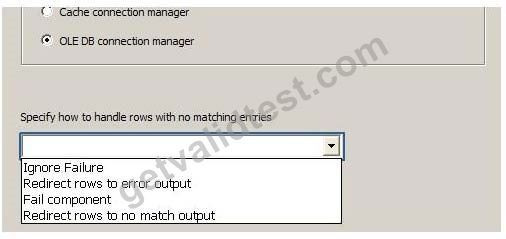
You need to configure the Lookup transformation to ensure that all records flow to the Conditional Split transformation, regardless of whether the rows match an existing row in the destination table.
Which setting should you select? (To answer, select the appropriate option in the answer area.)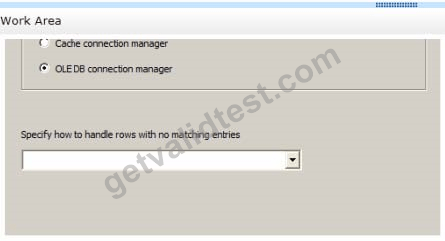
2. Note: This question is part of a series of questions that use the same set of answer choices. An answer choice may be correct for more than one question in the series.
You administer a SQL Server 2012 server that contains a database named SalesDb. SalesDb contains a schema named Customers that has a table named Regions. A user named userA is a member of a role named Sales.
UserA is granted the Select permission on the Regions table. The Sales role is granted the Select permission on the Customers schema.
You need to ensure that UserA is disallowed to select from any of the tables in the Customers schema.
Which Transact-SQL statement should you use?
A) REVOKE SELECT ON Schema::Customers FROM UserA
B) DENY SELECT ON Schema::Customers FROM Sales
C) REVOKE SELECT ON Object::Regions FROM UserA
D) REVOKE SELECT ON Schema::Customers FROM Sales
E) DENY SELECT ON Object::Regions FROM Sales
F) REVOKE SELECT ON Object::Regions FROM Sales
G) DENY SELECT ON Object::Regions FROM UserA
H) EXEC sp_addrolemember 'Sales', 'UserA'
I) EXEC sp_droprolemember 'Sales', 'UserA'
J) DENY SELECT ON Schema::Customers FROM UserA
3. DRAG DROP
You are building a SQL Server Integration Services (SSIS) package to load product data sourced from aWindows Azure SQL Database database to a data warehouse. Before the product data is loaded, you create a batch record by using an Execute SQL task named Create Batch. After successfully loading the product data, you use another Execute SQL task named Set Batch Success to mark the batch as successful.
You need to create and execute an Execute SQL task to mark the batch as failed if either the Create Batch or Load Products taskfails.
Which three steps should you perform in sequence? (To answer, move the appropriate actions from the list of actions to the answer area and arrange them in the correct order.)
4. You are designing a SQL Server Integration Services (SSIS) data flow to load sales transactions from a source system into a data warehouse hosted on Windows Azure SQL Database. One of the columns in the data source is named ProductCode.
Some of the data to be loaded will reference products that need special processing logic in the data flow.
You need to enable separate processing streams for a subset of rows based on the source product code.
Which Data Flow transformation should you use?
A) Conditional Split
B) Source Assistant
C) Multicast
D) Script Task
5. You are developing a SQL Server Integration Services (SSIS) package to load data into a data warehouse. The package consists of several data flow tasks.
The package experiences intermittent errors in the data flow tasks.
If any data flow task fails, all package error information must be captured and written to a SQL Server table by using an OLE DB connection manager.
You need to ensure that the package error information is captured and written to the table.
What should you do?
A) Use an event handler for OnError for the package.
B) Use an event handler for OnError for each data flow task.
C) Enable the SSIS log provider for SQL Server for OnError in the package control flow.
D) Create a SQL Server Agent job to execute the SSISDB.catalog.validate_project stored procedure.
E) Store the System::SourceID variable in the custom log table.
F) Deploy the project by using dtutil.exe with the /COPY DTS option.
G) View the All Messages subsection of the All Executions report for the package.
H) Create a table to store error information. Create an error output on each data flow destination that writes OnError event text to the table.
I) Create a table to store error information. Create an error output on each data flow destination that writes OnTaskFailed event text to the table.
J) Create a SQL Server Agent job to execute the SSISDB.catalog.validate_package stored procedure.
K) Deploy the .ispac file by using the Integration Services Deployment Wizard.
L) Deploy the project by using dtutil.exe with the /COPY SQL option.
M) Enable the SSIS log provider for SQL Server for OnTaskFailed in the package control flow.
N) Store the System::ServerExecutionID variable in the custom log table.
O) View the job history for the SQL Server Agent job.
P) Use an event handler for OnTaskFailed for the package.
Q) Create a SQL Server Agent job to execute the SSISDB.catalog.create_execution and SSISDB.catalog.*tart_execution stored procedures.
R) Store the System::ExecutionInstanceGUID variable in the custom log table.
Solutions:
| Question # 1 Answer: Only visible for members | Question # 2 Answer: J | Question # 3 Answer: Only visible for members | Question # 4 Answer: D | Question # 5 Answer: C |