If you think that you have enough time to prepare your TS: Accessing Data with Microsoft .NET Framework 4 actual test, we will provide you with the latest study materials so that you can clear TS: Accessing Data with Microsoft .NET Framework 4 valid test with full confidence. Our website has focused on providing our candidates with the most reliable Microsoft braindumps torrent with the best quality service. We are here to offer you instant help so that you can get high scores in the 070-516 valid test. Our latest training materials and test questions will surely give you all want for TS: Accessing Data with Microsoft .NET Framework 4 pass test guaranteed. Many candidates realized that it is exhausted thing to join the classes and prefer to choose our TS: Accessing Data with Microsoft .NET Framework 4 exam braindumps as their prior pass guide. Our MCTS test questions and answers are the best learning materials for preparing their certification.

You must be heard that our latest 070-516 test answers can ensure candidates clear exam with 100% and covers everything you want to solve the difficulties of TS: Accessing Data with Microsoft .NET Framework 4 test questions. All study materials are concluded and tested by our team of IT experts who are specialized in TS: Accessing Data with Microsoft .NET Framework 4 valid dumps. We always keep the updating of our study materials so that our candidates get high marks in the Microsoft actual test with great confidence. Besides, there are free demo you can download to check the accuracy of TS: Accessing Data with Microsoft .NET Framework 4 test answers.
There are three versions for the preparation of your TS: Accessing Data with Microsoft .NET Framework 4 braindumps torrent. One is Pdf version that can be printable and shared your TS: Accessing Data with Microsoft .NET Framework 4 test questions with your friends. The test engine and online test engine is exam simulation that bring you feel the atmosphere of 070-516 valid test. Online version allows you practice your questions in any electronic equipment without limitation. You can check the test result of TS: Accessing Data with Microsoft .NET Framework 4 exam braindumps after test.
Our aim is offering our customer the most accurate TS: Accessing Data with Microsoft .NET Framework 4 exam braindumps and the most comprehensive service, that's our key of success. You will enjoy one-year free update once you purchased our TS: Accessing Data with Microsoft .NET Framework 4 valid dumps. And once we have any updating about 070-516 test answers, we will send it to your email immediately. Besides, we promise you full refund if you failed exam with our TS: Accessing Data with Microsoft .NET Framework 4 pass test guaranteed materials. Please feel free to contact us if you have any questions.
After purchase, Instant Download: Upon successful payment, Our systems will automatically send the product you have purchased to your mailbox by email. (If not received within 12 hours, please contact us. Note: don't forget to check your spam.)
Microsoft 070-516 Exam Syllabus Topics:
| Section | Weight | Objectives |
|---|---|---|
| Topic 1: Managing Connections and Context | 18% | - Manage concurrency
|
| Topic 2: Developing and Deploying Reliable Applications | 18% | - Deploy and configure
|
| Topic 3: Querying Data | 22% | - Query with WCF Data Services
|
| Topic 4: Modeling Data | 20% | - Define and model data structures
|
| Topic 5: Manipulating Data | 22% | - Insert, update, and delete data
|
Microsoft TS: Accessing Data with Microsoft .NET Framework 4 Sample Questions:
1. You use Microsoft Visual Studio 2010 and Microsoft .NET Framework 4.0 to create an application.
You use a TableAdapter object to load a DataTable object.
The DataTable object is used as the data source for a GridView control to display a table of customer
information on a Web page.
You need to ensure that the application meets the following requirements:
-Load only new customer records each time the page refreshes.
-Preserve existing customer records. What should you do?
A) Set the ClearBeforeFill property of the TableAdapter to false. Use the GetData method of the TableAdapter to create a new DataTable.
B) Set the ClearBeforeFill property of the TableAdapter to true. Use the Fill method of the TableAdapter to load additional customers.
C) Set the ClearBeforeFill property of the TableAdapter to true. Use the GetData method of the TableAdapter to create a new DataTable.
D) Set the ClearBeforeFill property of the TableAdapter to false. Use the Fill method of the TableAdapter.
2. You use Microsoft Visual Studio 2010 and Microsoft .NET Framework 4.0 to develop an application.
You use the ADO.NET Entity Framework Designer to model entities. You retrieve an entity from an object
context.
A different application updates the database. You need to update the entity instance to reflect updated
values in the database.
Which line of code should you use?
A) context.LoadProperty(entity, "Server", MergeOption.OverwriteChanges);
B) context.Refresh(RefreshMode.StoreWins, entity);
C) context.LoadProperty(entity, "Client", MergeOption.OverwriteChanges);
D) context.AcceptAllChanges() ;
3. You use Microsoft Visual Studio 2010 and Microsoft .NET Framework 4.0 to create a Windows Communication Foundation (WCF) Data Services service. The solution contains the projects shown in the following table.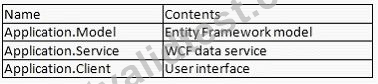
The WCF data service exposes an Entity Framework model. You need to Access the service by using a
WCF Data Services client.
What should you do in the Application.Client Project?
A) Add a referance to the Application.Model Project.
B) Add a service reference that uses the URL of the WCF data service.
C) Add a web reference that uses the URL of the WCF data service.
D) Add a referance to the Application.Service Project.
4. You use Microsoft .NET Framework 4.0 to develop an application that connects to a Microsoft SQL Server
200B database.
You populate a SqlDataAdapter by using the following code. (Line numbers are included for reference only.)
01 SqlDataAdapter dataAdapter1 = new SqlDataAdapter("SELECT * FROM
[BlogEntries] ORDER BY CreationDate", connection);
02 cmdBuilder = new SqlCommandBuilder(dataAdapter1);
03 dataAdapter1.Fill(BlogEntryDataSet, "BlogEntries");
04 ....
05 connection.Close();
You need to update the blog owner for all BlogEntry records. Which code segment should you insert at line 04?
A) foreach(DataRow row in BlogEntryDataSet.Tables["BlogEntries"].Rows) {
row.Item["BlogOwner""] = "New Owner";
}
dataAdapter1.Update(BlogEntryDataSet, "BlogEntries");
B) foreach(DataRow row in BlogEntryDataSet.Tables["BlogEntries"].Rows) {
row.Item["BlogOwner""] = "New Owner";
}
dataAdapter1.Fill(BlogEntryDataSet, "BlogEntries");
C) SqlDataAdapter dataAdapter2 = new SqlDataAdapter("UPDATE [BlogEntries] SET [BlogOwner] = "New
'Owner' 3", connection);
dataAdapter2.Update(BlogEntryDataSet, "BlogEntries");
D) SqlDataAdapter dataAdapter2 = new SqlDataAdapter(dataAdapterl.UpdateCommand); dataAdapter2.Fill(BlogEntryDataSet, "BlogEntries");
5. Which one of these samples it the correct way to close the connection using Command Behavior?
A) SqlDataReader rdr = new SqlDataReader(); string sql = @"sql statement"; SqlConnection conn = connection.GetConnection(); SqlCommand cmd = new SqlCommand(sql, conn); SqlDataReader rdr = cmd.ExecuteReader(CommandBehavior.CloseConnection); rdr.Close(); Console.WriteLine("{0}", rdr);
B) using (SqlDataReader rdr = new SqlDataReader())
{
string sql = @"sql statement";
SqlConnection conn = connection.GetConnection();
SqlCommand cmd = new SqlCommand(sql, conn);
SqlDataReader rdr = cmd.ExecuteReader(CommandBehavior.CloseConnection);
Console.WriteLine("{0}", rdr);
}
C) SqlDataReader rdr = new SqlDataReader(); string sql = @"sql statement"; SqlConnection conn = connection.GetConnection(); SqlCommand cmd = new SqlCommand(sql, conn); SqlDataReader rdr = cmd.ExecuteReader(CommandBehavior.CloseConnection); Console.WriteLine("{0}", rdr);
D) SqlDataReader rdr = new SqlDataReader(); string sql = @"sql statement"; SqlConnection conn = connection.GetConnection(); SqlCommand cmd = new SqlCommand(sql, conn); SqlDataReader rdr = cmd.ExecuteReader(CommandBehavior.CloseConnection); conn.Close(); Console.WriteLine("{0}", rdr);
Solutions:
| Question # 1 Answer: D | Question # 2 Answer: B | Question # 3 Answer: B | Question # 4 Answer: A | Question # 5 Answer: A |